
Cable screen ungrounded by mistake
On AC 50 Hz lines built with single-core cables, induced (circulating) currents and associated power losses occur when the screens are solidly bonded. These currents and losses become especially dangerous when phases:
➡️ have an increased screen cross-section (say, more than 50-70 mm2);
➡️ arranged not in a trefoil, but in row, at a distance from each other.
These conditions are most typical in 110-500 kV networks, and to a lesser extent for 6-35 kV. Therefore, it is in 110-500 kV networks that if we see a line with solid bonding of the screens, then most likely this is a design error, and it will cost a lot. There are two recommended options to choose from:
✅ single-point bonding of the screens;
✅ cross-bonding of the screens.
In practice, periodic manipulation with screens is necessary. For example, this is required when testing the outer sheath of cables with a DC 10 kV voltage. For such tests, the line is disconnected from the network, and the screens at the ends must be unbonded and ungrounded.
Unfortunately, there are cases when, after testing, personnel forget to bring the bonding/grounding back to its proper state. Let us look at the consequences of operating such a line.
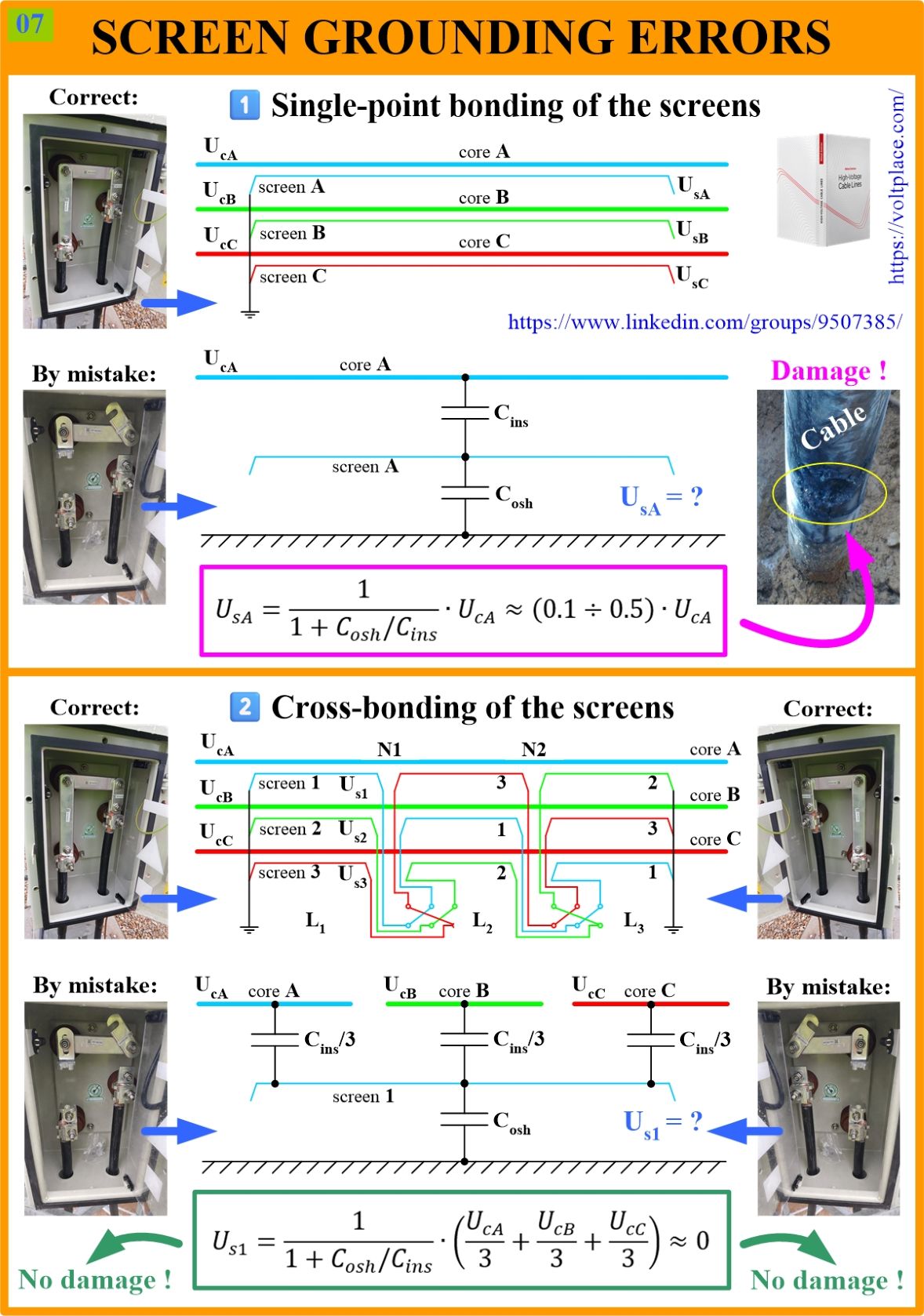
1️⃣ For a line without cross-bonding, if the line is turned on, but the screen is completely ungrounded, then the AC 50 Hz voltage on the screen is determined through capacitances (C):
👉 between the core and the screen (insulation, Cins);
👉 between the screen and the ground (outer sheath, Cosh).
Depending on the laying conditions (in the ground or in the air), the capacitance Cosh may be different, and the screen voltage (Us) can be from 10 to 50% of the core voltage (Uc). This voltage (Us) is enough to damage the sheath of the cable.
2️⃣ For a line with a cross-bonding, if the line is turned on, but the screen is completely ungrounded, then the AC 50 Hz voltage on the screen is determined through capacitances. However, due to the cross-bonding, every screen (1,2,3) belongs to three different cores at once (A, B,C), and this compensates for the currents passing onto the screen, and there is no voltage on the screen (Us=0).
The screens are not grounded (by mistake), but we have a good result:
✅ Is=0: the absence of circulating currents (as for any cross-bonding);
✅ Us=0: the absence of screen voltage (although, for normal cross-bonding, there is an induced voltage Us>0).
Does it turn out that cross-bonding without grounded screens (Is=0, Us=0) is even better than cross-bonding with grounded screens (Is=0, Us>0)?
Seems, that yes. However, there is one nuance – if the voltage in one of the cores A,B,C disappears (for example, there is an external short circuit in the network), then the compensation of capacitive currents will be disrupted, and a screen voltage (Us) reaching 0.1-0.5 of the core phase voltage (Uc) will immediately appear on the screen and cause a breakdown of the sheath, as it was in the case 1️⃣.
You can read one of the previous posts on this topic using the link.