
Cable cleat calculations
When laying cables along structures, as well as near the terminations and joints, cables should be fixed. It is necessary because the cables are in the magnetic field of their neighbours, and according to Ampere’s law, forces arise between the cables:
➡️ In normal mode.
➡️ When switching cables.
➡️ In case of a short circuit.
The most dangerous forces occur during short circuits. The force between the cables is proportional to the current in each of the cables, and therefore single-phase short circuits are not considered when calculating the forces. All attention is paid to two-phase and three-phase short circuits.
At 50 Hz, the force between the cables varies over time, and the cables “oscillate” at twice the frequency of the current. Cables can move:
👉 To each other (if the currents in them are of the same sign).
👉 From each other (if the currents in them are of different signs).
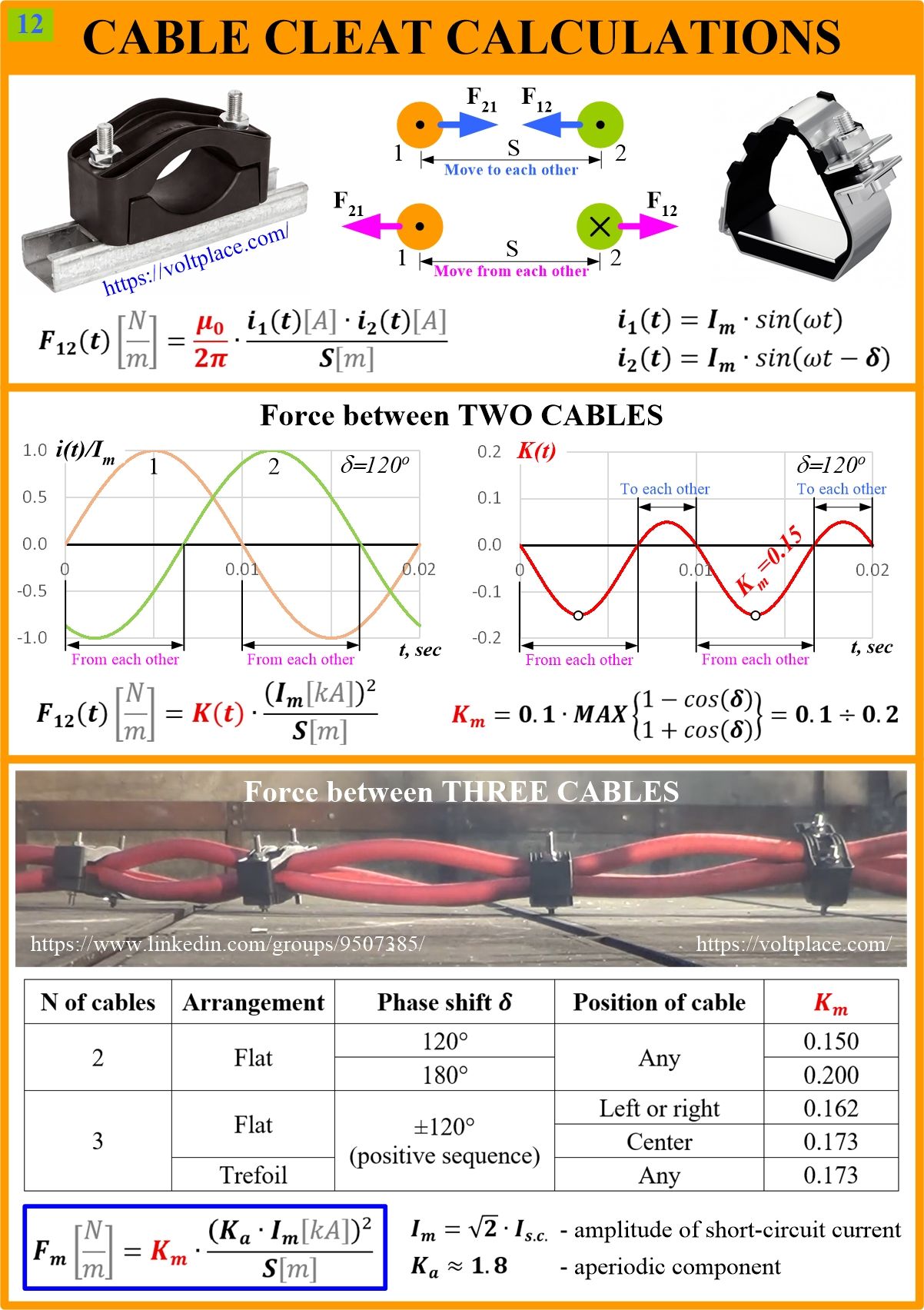
For two-phase short circuit (two cables), an example of currents and forces is shown in the figures. For the phase shift of 120°, the coefficient Km =0.15 can be used to calculate the maximum force (Fm). In general, for a two-phase short circuit, the currents in two cables may not have a shift of 120° (due to the presence of zero sequence). Therefore, it can be Km=0.1-0.2.
For three-phase short circuit (three cables), the situation is more complicated, since the force on each cable is determined not by one neighbour, but by two at once, and the sum of force vectors is required. However, it is convenient that a three-phase short circuit is always a positive sequence mode (without zero), and therefore the shift between the sinusoids of the currents of phases A, B, C is always 120°.
The results of calculating the coefficients (Km) for two-phase and three-phase short circuits are shown in the table. It can be seen that coefficient (Km) is almost always less than 0.2.
In the general case, the force calculation should take into account that currents are not only sinusoids, but also have aperiodic components, which is reflected in the formula shown at the bottom. According to this formula, based on the short-circuit current (usually three-phase), the force between the cables is determined and the following is selected:
✅ The cleats required for withstanding such a force.
✅ The distance between the cleats (the formula gives the force per 1 m length).
Interestingly, cleat manufacturers like to make videos of how their cleats withstand large forces between cables. On such videos, they always indicate the short-circuit current and time, but rarely indicate other key information:
👉 The presence of an aperiodic component and the rate of its attenuation.
👉 The distance (S) between the axes of the cables.
👉 The distance between the cleats (number of cleats per 1 m).
👉 The damage to the cable outer sheath caused by the cleats (it’s good that the cleats withstood the short circuit in operation, but could we use a deformed cable then?).
AFTERWORD
There is an international standard IEC 61914 that covers cable cleat testing. However there are many things missing in this IEC. For example, it doesn’t contain:
1️⃣ The concept of the “shift between currents”, on which the force depends. This concept is demonstrated in the post using the example of two cables.
2️⃣ The ratio of positive and zero sequence currents and their effect on the forces between the cables.
3️⃣ The attenuation rates of the aperiodic component (it can be very different, and this is not mentioned, and it is not normalized in any way in the standard).
4️⃣ The concept of not only the maximum force, but also the effective value of the force (since the force is variable during the period).
5️⃣ Checking not only the cleats for “passed” or “failed”, but also the inspection of the cables. There are cleats on the market that meet this IEC 61914, but in fact they damage the cable in many places when it is short-circuited.
6️⃣ etc.
I don’t think that IEC 61914 is OK. Publications like this post are very good at showing what is wrong and what needs to be changed. It’s never too late to learn. The cable industry is constantly changing.