
Large cross-section of the conductor
Throughout the history of power cable lines, the maximum conductor (core) cross-section was constantly increasing. Once upon a time, a cross section of 1000 mm2 was considered a large. However, at present, the 2500 mm2 is no surprise to anyone, and there are already projects where the cross-section reaches 3200-3500 mm2 and even 4000 mm2 has been announced. Today we will not discuss who needs such large cross-sections and how effective such cables are, but only discuss some of the consequences of increasing the conductor cross-section.
Cables with a large cross-section (let it be cables with a cross-section of over 2500 mm2) are so expensive and responsible that a special group, CIGRE WG B1.102, was created to discuss the features and potential problems of large-section conductors. The first in-person meeting of WG B1.102 was held in mid-June 2026 at the Prysmian headquarters in Milan.
The Group plans to work for several years, and as a result, it is expected that a new technical brochure will be published. During these years, it is planned to discuss what new problems arise when the cross-section is larger than 2500 mm2:
🔹 optimal design of large cross-section conductors
🔹 electric and geometric parameters of large cross-sections
🔹 electrical resistance of the conductors and methods of measuring them
🔹 features of conductor design for HVAC and HVDC projects
🔹 permissible bending radius of the conductor and entire cable
🔹 permissible pulling forces and distribution of forces over the cross-section
🔹 methods of connecting single wires and conductors (welding, connectors)
🔹 requirements for conductor connectors and their testing
🔹 values of thermomechanical forces arising from temperature fluctuations
🔹 thermal inertia and the associated overload capacity of the cable line
🔹 the behaviour of the conductors during short circuits
🔹 etc, etc, etc.
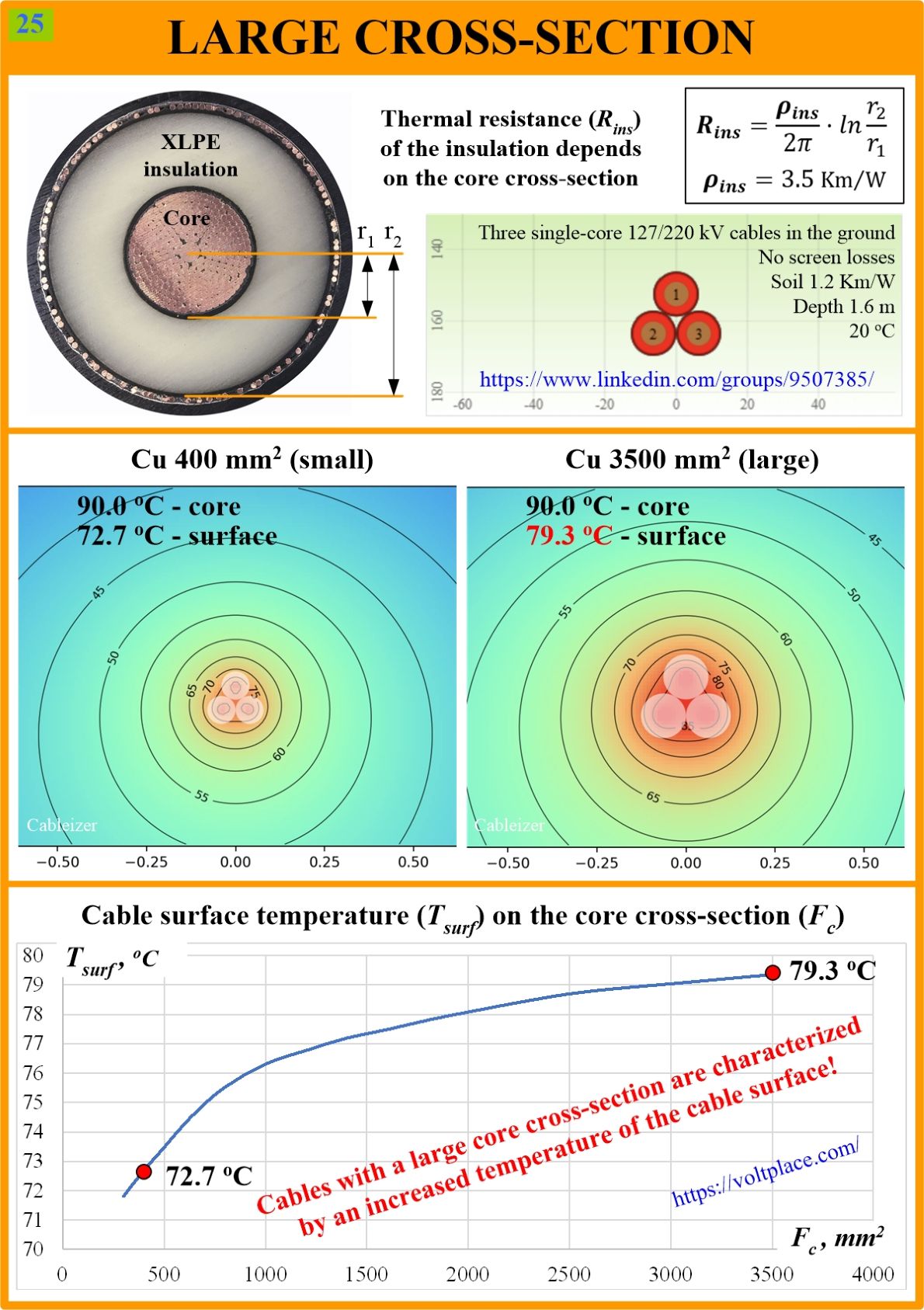
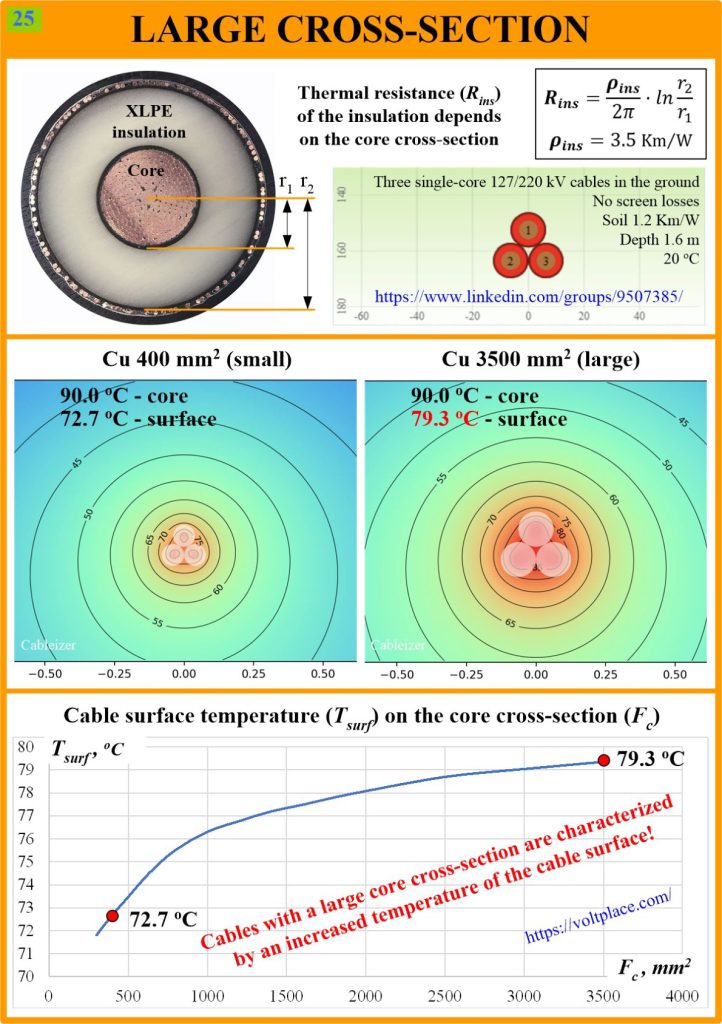
Today, let us demonstrate a simple fact – an increase in the conductor cross-section leads to an increase in the temperature of the outer surface of the cables. The thing is that as the cross-section increases, the ratio of radii r2/r1 decreases, and with it the thermal insulation resistance (Rins) decreases, which means it is easier for heat to reach the outer surface. Thus, the surface temperature tends to the temperature of the conductor (90℃ for XLPE-insulated cables).
What does an increase in cable surface temperature mean? For example, it means that cable lines with large cross-sections may get the following problems:
♨️ more intensive drying of the soil (risks of thermal runaway)
♨️ more difficult working conditions of the cable jacket and cable couplings
♨️ higher requirements for cable cleats, pipes, pipe sealants
You can discuss this post on LinkedIn, in the “High Voltage Cable Lines” group, by following the link to the post.