
Safety in cross-bonding nodes
Cross-bonding of screens is common for HVAC lines. It is performed using link boxes placed along the line and which have jumpers inside for connecting screens’ sections and sheath voltage limiters (SVL). It is necessary to make a grounding of the boxes, and this is a definite problem due to the fact that there is often limited space around the boxes, especially in populated areas. Therefore, it is difficult to make the grounding there similar to what we have for switchgear (< 0.5 Ω), and the question arises – how much is enough (2 Ω, 5 Ω, etc.)?
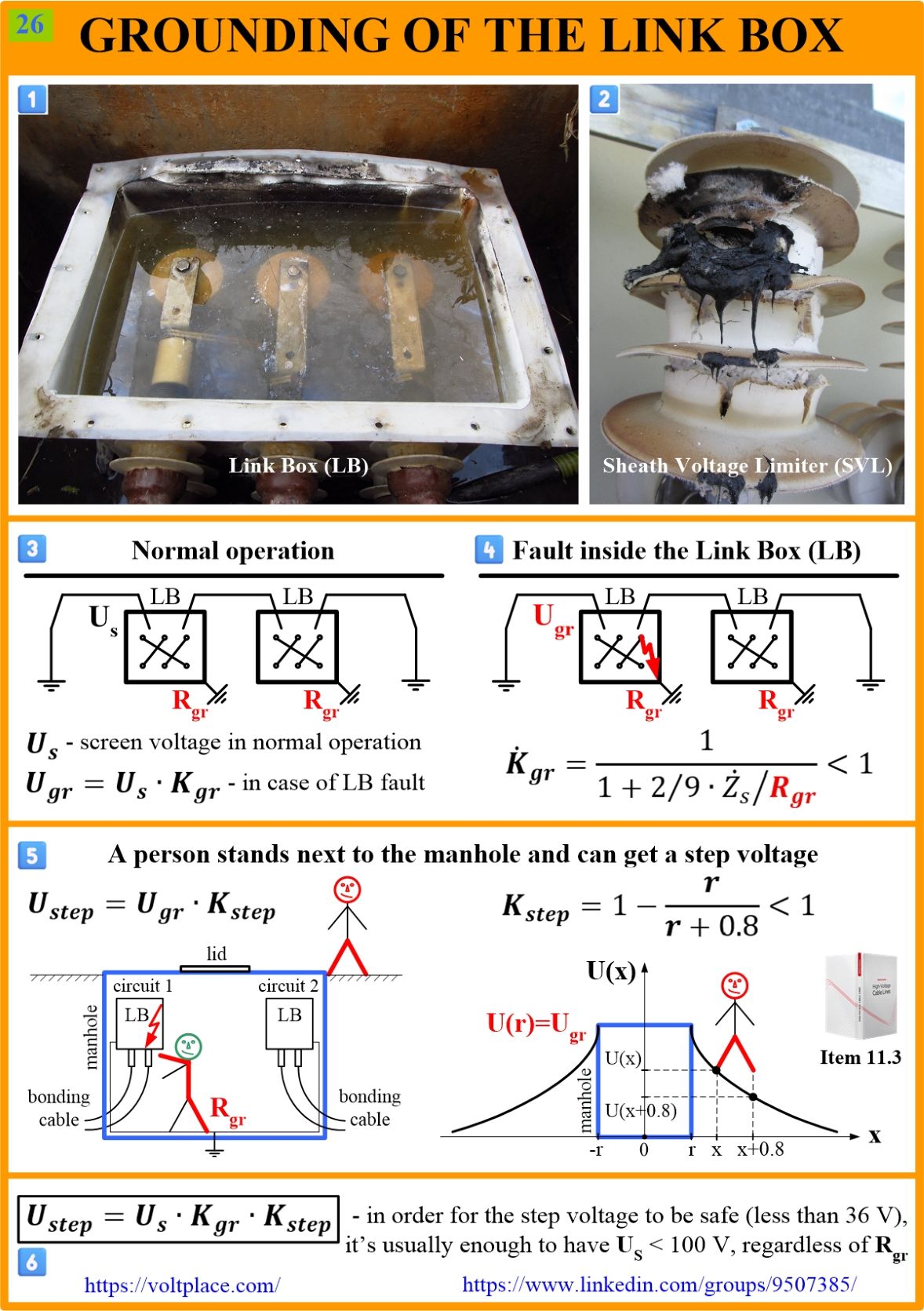
If the insulation in the box is damaged (photos 1️⃣, 2️⃣), then the screen may receive a connection to the box’s body. In this case, the electric potential of the screen (Us) and the box will become equal to each other, and equal to the potential of the grounding (Ugr), that is:
↘️ the potential of the screen will decrease (from Us to Ugr).
↗️ the potential of the box will increase (from 0 to Ugr).
The potential of the screen (and hence on the body of the damaged box) can be in a normal mode 3️⃣, in cases of short circuits (in the network or in the line) and transients (switching, lightning). However, the first thing to think about is a normal mode – let us focus only on it today.
According to the formula 4️⃣ obtained in Item 11.3 of the book “High Voltage Cable Lines“, the specific value of the voltage (Ugr) depends not only on the grounding impedance (Rgr), but also on the active-inductive impedance of the cable screen (Zs), that is:
🔹on the cross-section and material of the screen.
🔹on the length of the line and the number of cross-bonding cycles.
The potential of the grounding (Ugr) could theoretically be dangerous:
⚡for the personnel inside the manhole.
⚡for people on the ground next to the manhole 5️⃣.
Since manholes are usually made of reinforced concrete, the electric potentials of points inside the manhole differ little from each other (they have a potential of Ugr), and we should not be afraid of the “touch voltage” inside. Therefore, let us focus on the people who are standing on the ground – they may find themselves in the zone where the potential of the soil drops (from Ugr to 0). As a result, people may be exposed to “step voltage” (Ustep). The value of this voltage (for a 0.8 m step) depends:
🔹on Ugr (this voltage was calculated before in 4️⃣).
🔹on the size of the manhole (its equivalent “radius” r – see formula 5️⃣).
🔹on covering of the surface around the manhole (soil, asphalt, gravel etc.).
For example 6️⃣, it turns out that if we select the number of sections of the cross-bonding so that there is Us < 100 V in normal mode, then Ustep will be less than 30-40 V for almost any grounding impedance (Rgr) and screen parameters (Zs). At the same time, if there is Us > 100 V in normal mode, chances are high that even with a grounding of Rgr < 0.5 Ω, the step voltage will be higher than the safe value. Therefore, it can be argued that safety is determined more by the Us value rather than by the Rgr value.
You can discuss this post on LinkedIn, in the “High Voltage Cable Lines” group, by following the link to the post.
COMMENT 1
The normal mode is interesting because it is long-lasting. At the same time, possible damage to the box (humidification, breakdown of the insulator or SVL) are not short circuits and are not disabled by the relay protection of the cable line. Therefore, a situation where an AC 50 Hz voltage exists for a long time on the body of the box and the manhole can last for months. How can we protect members of the society? We have two main options:
✅ reduce Rgr (but even Rgr < 0.5 Ω may be not safe enough, not to mention that even 3-5 Ω is difficult to reach around the manhole).
✅ reduce Us (if Us < 100 V than we get high safety regardless of Rgr).
If parameters of the cable line (length, number of cross-bonding cycles etc.) are such that in normal mode Us > 100 V, then we need to be very careful about the safety measures at the cross-bonding nodes.
COMMENT 2
A simple formula was derived in the book that shows that, in fact, even large changes in Rgr will not significantly change safety issues. It is much more profitable to design the cable line so that the screen voltage (Us) is less than 100 V in normal operation – this solves many problems.
There are cable projects where the Us reaches not 100 V but up to 400 V. This can be safe only if the condition of the boxes is monitored automatically in real time, and not manually by staff with a regularity of once every few years.
COMMENT 3
The larger the size of a concrete manhole, the lower the step voltage around it. There is another option to improve safety – polymer manholes. They are made of dielectric and don’t have any problems with step voltage.