Cable lines - transients / 25.04.2024

Sheath Voltage Limiters (SVL) and their damages

Single-core cables with XLPE insulation are massively used in 110-500 kV networks. Solid (two-sided) grounding of the screens of such cables leads to negative consequences, and therefore, as a rule, for screens should be used:✅Single-point grounding (see diagram)✅Cross-bonding. In both schemes, voltages may occur on screens relative to the ground caused by interference from the

Read More
Cable lines - ducts / 11.04.2024

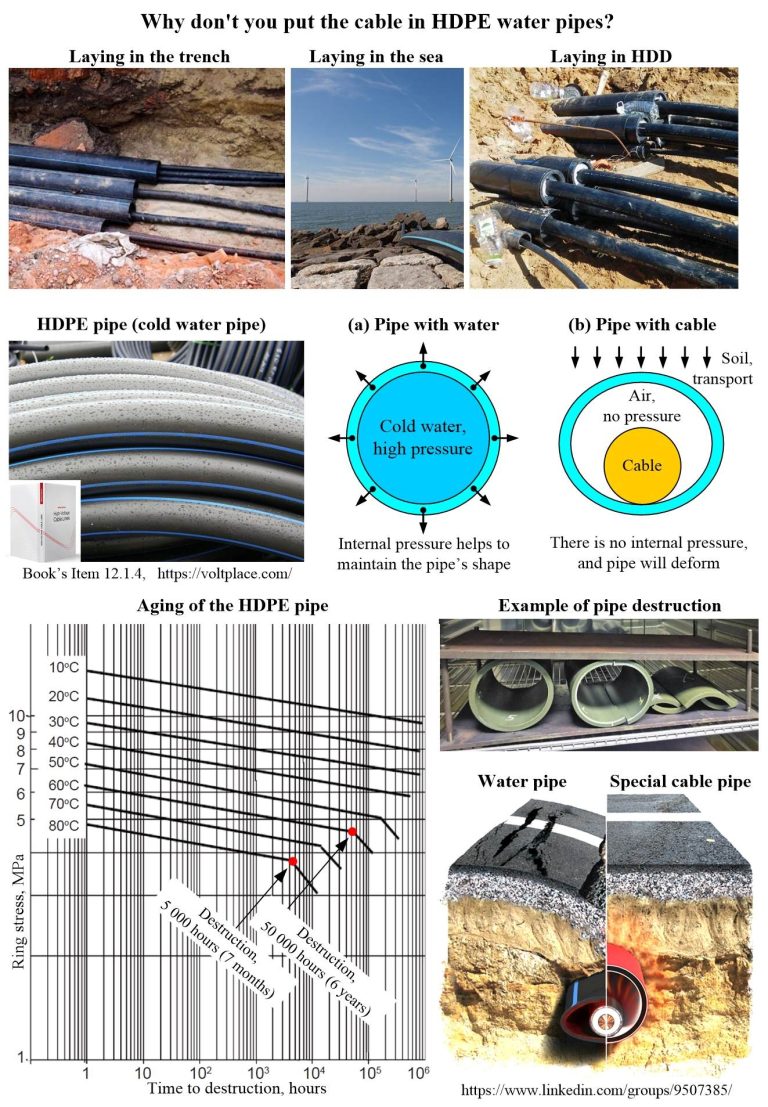
Cable ducts can hide issues

All over the world, more and more cable lines are laid not in the ground, but in ducts (conduits, pipes). Such ducts are made of various materials (PE, HDPE, PE-RT, PP, PVC), they can be single-layer or multi-layer. But all these ducts have one common problem – they have “infinite” impedance Rd of the side

Read More
Cable lines - ducts / 28.03.2024

Long vertical cable pipe = good heater

Cable terminations are a weak element of the cable line, since:✅they have a complex structure;✅they are mounted manually (and the quality of installation depends on the qualification of the installer and his mood);✅they are subject to various external influences (sun, wind, rain, snow, ice etc). When a cable termination is damaged, it is not always

Read More
Cable lines - parameters / 18.03.2024

Cable capacitance is able to surprise

The electrical capacitance of cables directly affects the arrangement of medium-voltage 6-35 kV networks with an isolated neutral, as well as issues of reactive power compensation of 110-500 kV networks. Let’s talk about what kind of capacitance the modern cables have. THE FIRST.When cables with cross-linked polyethylene (XLPE) insulation appeared, we were told that these

Read More
Cable lines - screen bonding / 07.03.2024

Two types of screen cross-bonding

In 6-500 kV networks, single-core cables with XLPE insulation are widely used. Such cables have conductive screens. In such screens, if they are grounded at both ends, AC 50 Hz currents are induced in normal mode and active power losses occur. This leads to additional heating of the XLPE, a decrease in the long-term permissible

Read More
Cable lines - not seriously / 13.02.2024

Crazy roundabout

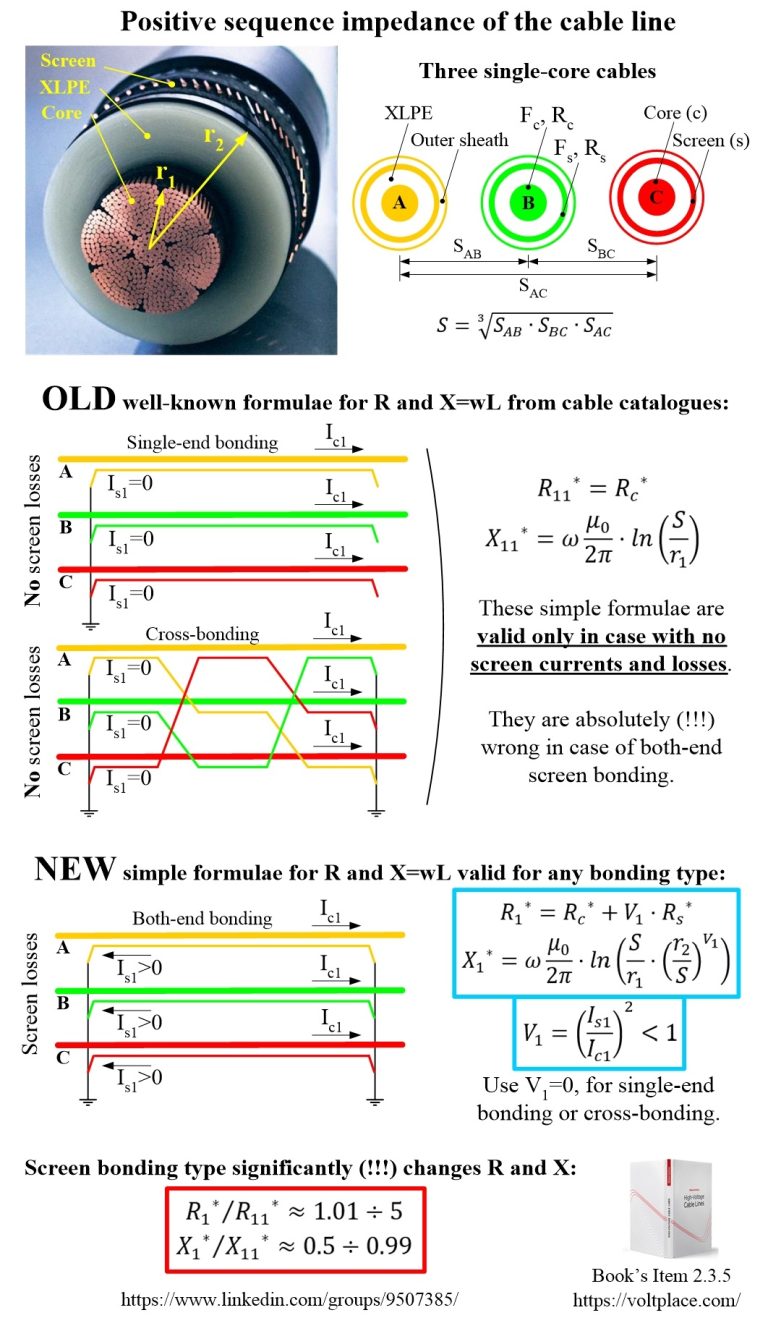
Designing a cable line is an interesting process that resembles moving in a circle. The fact is that in order to select cables, we need the correct values of the short-circuit current (1.1) and the steady-state current (1.2). Such currents can only be calculated using information about the impedances of the cable line (R1, X1,

Read More
Cable lines - safety / 02.02.2024

The magnetic field – it exists!

When designing cable lines, it is very rare to find such projects where there is a section of documentation in which calculations of the magnitude of the magnetic field H of the cable line would be carried out. At the same time, the magnetic field H can pose a significant danger, primarily under the following

Read More
Overhead lines and reactors / 29.01.2024

Breaker vs Reactor (part 2)

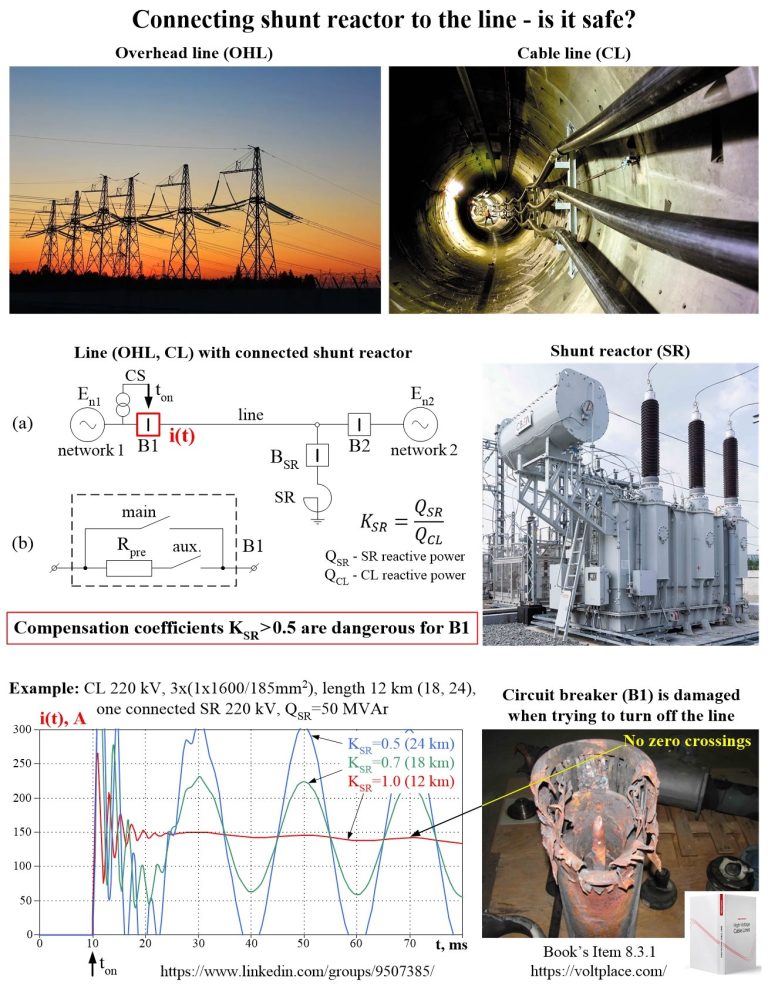
The previous post was about the reasons why switching lines with shunt reactors (SR) can cause damage of the line breaker B1. Theoretically, several options can be proposed to solve the problem. Let’s start with controlled switching devices (CS, see scheme). CS can be used only in cases when each phase of the breaker has

Read More