
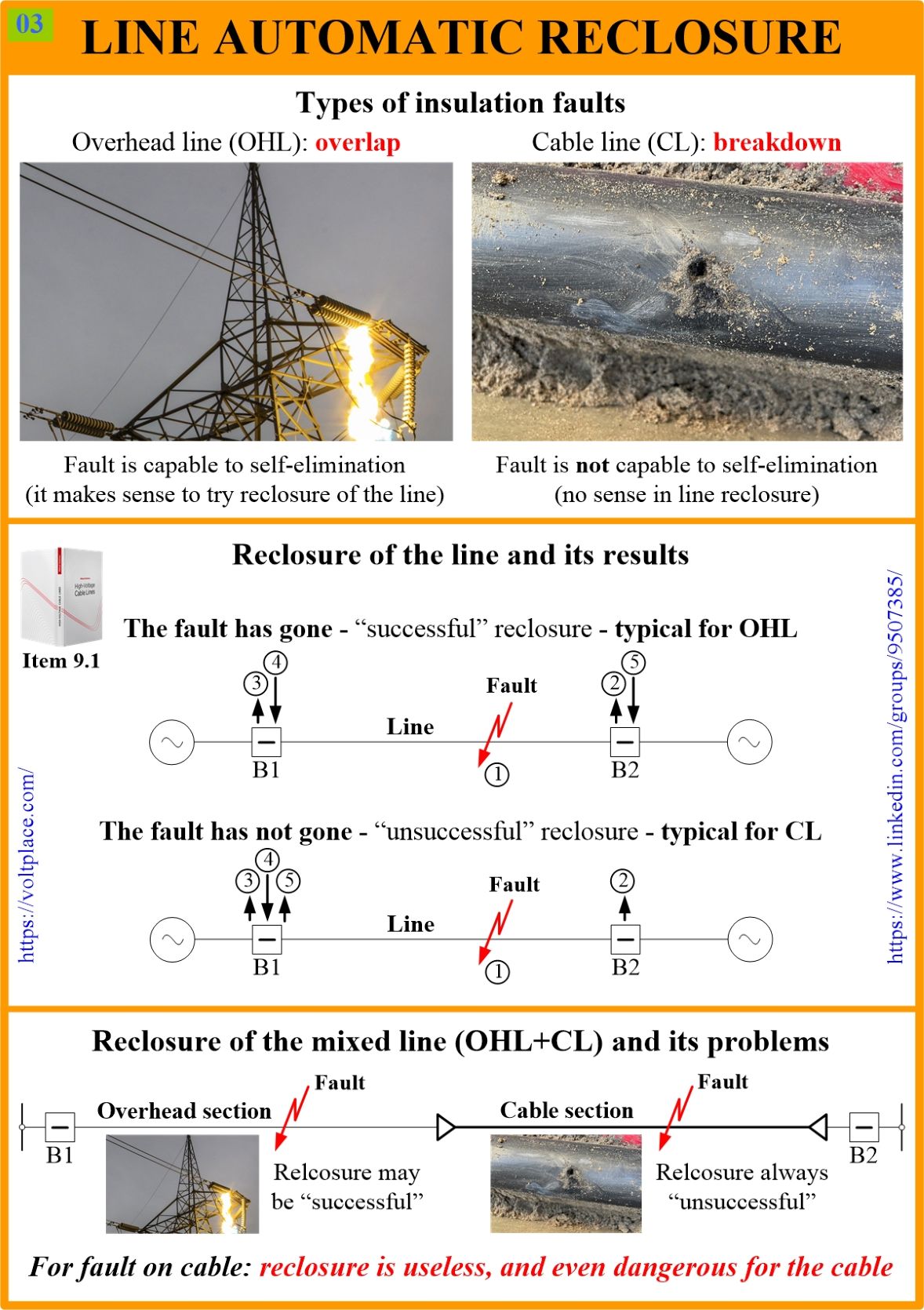
Automatic reclosure of the cable line
If a short circuit occurs on the line, the line is switched off. However, what to do next depends on the type of the line:
1️⃣ overhead line;
2️⃣ cable line;
3️⃣ mixed line, having both overhead and cable sections.
1️⃣ OVERHEAD LINE
For an overhead line, up to 60-90% of faults are associated with short-term overlaps of air gaps. After disconnecting the line, such damages are capable to self-elimination. Thus, the voltage can be safely applied to the line, and in 60-90% of cases the line will return to its normal operation. This process has a name of “automatic reclosure” (AR).
In case of “successful” AR, there are the following events:
🔹1 – short circuit;
🔹2,3 – disconnecting breakers (B) at the ends of the line;
🔹4 – approbation the line with network voltage;
🔹5 – closing the line in transit.
For overhead lines only in 10-30% of cases, fault is not capable to self-elimination. It can be so in case of a conductor falling to the ground, or a tree laying on the line etc. In such cases, the AR will be “unsuccessful”, and there are the following events:
🔹1 – short circuit;
🔹2,3 – disconnecting breakers (B) at the ends of the line;
🔹4 – approbation the line with network voltage, but the line still has a fault;
🔹5 – final disconnecting the line.
It can be seen that, for unsuccessful AR, the short-circuit current has passed through the line twice which is not so good.
2️⃣ CABLE LINE
If there is a fault on the cable, then this is a “hole” in the insulation, and it will almost never be capable to self-elimination. Thus, the AR for the cable is guaranteed to be unsuccessful. It is important that AR is not only useless, but even dangerous, since it will cause a re-passage of a short-circuit current, which lead to:
👉 overheating of the insulation along the line (usually the screen is selected for a single current passage, but not multiple in a short period of time);
👉 damage to neighbouring cables adjacent to the initially damaged one;
👉 wasting of the resource of circuit breakers (B1, B2);
👉 deformation of the windings of power transformers of the network.
3️⃣ MIXED LINE
Suppose, the line has overhead and cable sections (sometimes, the number of cable sections on an overhead line can be up to 2-3 or more). If there is a fault on this mixed line, the line will be disconnected, but is it possible to do automatic reclosure (AR)?
👉 if the fault was on the overhead section, then AR is possible and safe;
👉 if the fault was on the cable section, then AR is useless and dangerous.
There are different options for how to deal with AR on mixed lines, and some thoughts are given in the book.
Sometimes on mixed lines, the decision is made to have AR, without trying to figure out exactly on which section the fault was. In such cases, it is crucial to select properly:
✅ the optimal cross-section of the cable screen;
✅ the possible number of attempts to reclosure the line;
✅ minimum safe time between attempts (cable should have enough time to cool down).
AFTERWORD
Of course, there are many interesting things here that cannot be described in one post. For example, in fact, damage to the cable insulation can disappear on its own. Of course, we are not talking about short circuits, but about so-called ground faults with currents of only a few tens of Amperes, typical for networks with an isolated neutral. Such currents can pass for a long time, the polyethylene melts, and it fills the place of insulation breakdown – this leads to self-healing of the cable, and the staff sees it as “the damage has repaired itself, and ground fault has gone” (although, of course, it won’t be for long).
Some things about automatic reclosure are written in such documents as CIGRE TB 587 and IEEE 1793-2012. It is better to have these documents. It is also recommended to read item 9.1 of the book “High Voltage Cable Lines”.