
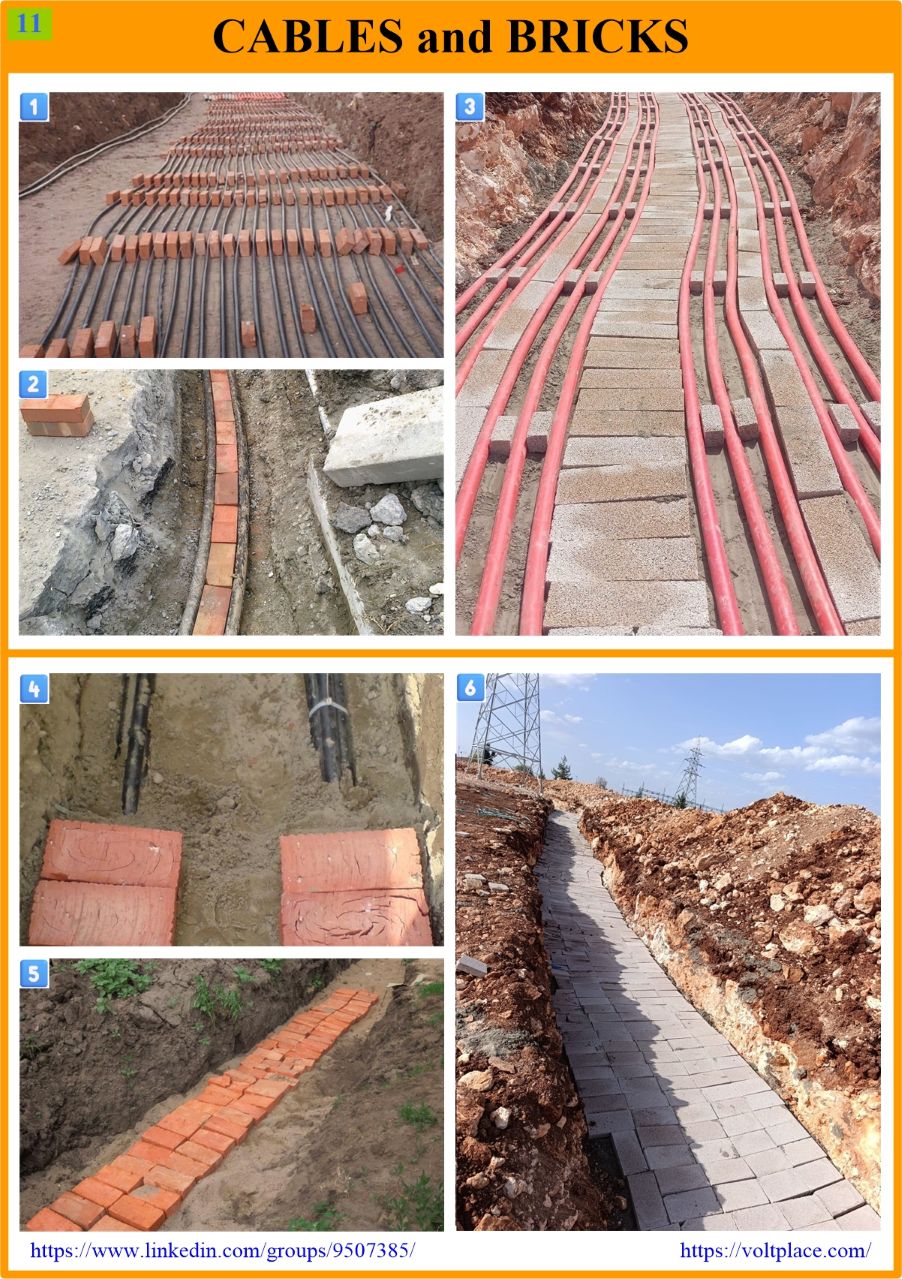
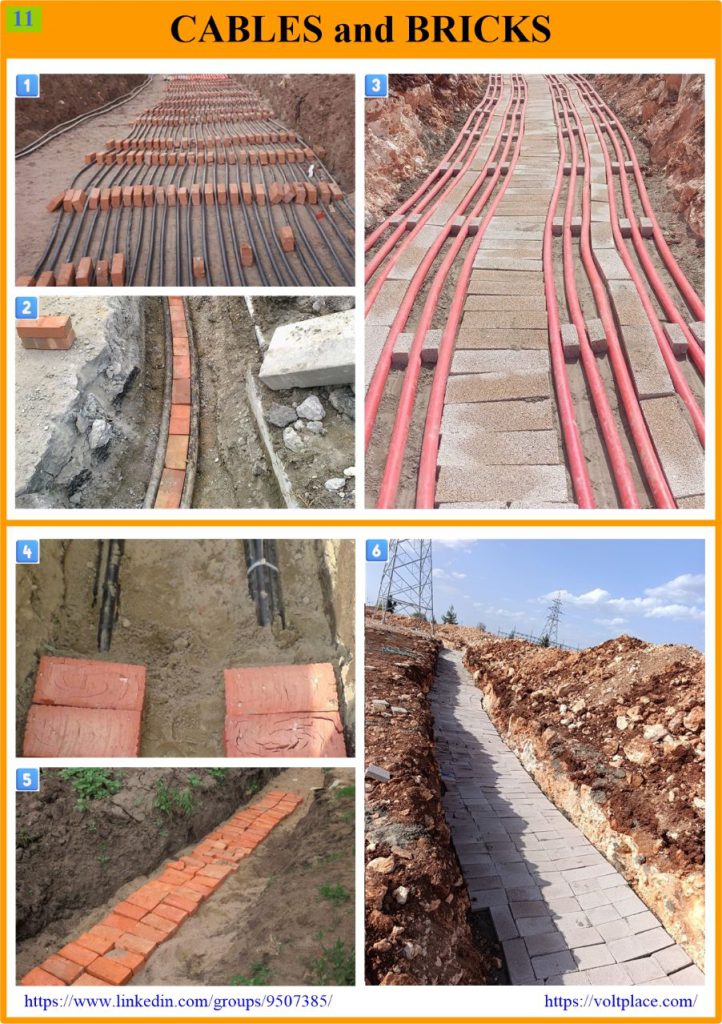
Cable protection by bricks
Today, let us talk about the bricks that can sometimes be found when laying low-voltage (up to 1 kV) and medium-voltage (up to 35 kV) cables in a trench. In general, the bricks can be used:
✅ between the cables (photos 1️⃣-2️⃣-3️⃣).
✅ above the cables (photos 4️⃣-5️⃣-6️⃣).
Bricks between the cables can have the following purposes:
1️⃣ Maintaining the distance between cables laid in parallel. It makes sense only for the time of laying cables, and loses its meaning after backfilling the trench.
2️⃣ Separation of parallel circuits, for example, in order to protect one circuit from the products of arc combustion that have arisen on another circuit. It starts working after the completion of the cable laying, trench backfilling, and putting the cable line into operation.
3️⃣ It is a combination of functions 1️⃣ and 2️⃣.
Bricks above the cables can have the following purposes:
4️⃣-5️⃣-6️⃣ Mechanical protection of the cables (basically, bricks help protect the cables only from above). It starts working after the completion of the cable laying, and trench backfilling.
The difference between 4️⃣-5️⃣-6️⃣ is due to the fact that these three cases provide different degree of mechanical protection and different cable cooling conditions (in normal operation).
The question – Is it good to use such a large number of bricks as shown? Let us talk about possible disadvantages:
👉 The transfer of a large number of bricks to the bottom of the trench often ends with one of the bricks falling out of the hands and causing serious damage to cable sheath.
👉 If the type of brick is chosen incorrectly, its thermal resistance can reach 2 Km/W, which is noticeably higher than that of the surrounding soil. In such conditions, a cable line covered from above with a continuous wide layer of bricks may overheat compared to the design conditions. Another problem there is that when performing thermal calculations of a cable line, the IEC 60287 lacks any recommendations on how to account for such a “Great Brick Wall”.
The above arguments suggest that perhaps laying bricks is not the best solution. Probably, bricks are acceptable mainly for low-voltage networks. As for medium-voltage networks, it is probably better to provide laying in modern polymer pipes instead of using any bricks.