
Cable protection in pipes
It is quite common to lay cables underground in pipes (let me please not use the word duct or conduit). There are probably three main ways to place pipes in the ground:
➡️ at the bottom of a trench;
➡️ in the borehole prepared by horizontal-directional drilling (HDD);
➡️ in the channel prepared by puncturing the ground.
The first two are the main ones. After laying the pipes in the ground, the cables are pulling into them. The following is recommended:
👉 before the pulling: installing of rollers at the pipe ends;
👉 during the pulling: lubricating the cables.
After the cable pulling is completed, the following actions are usually performed:
➡️ the cable terminations and joints are installed;
➡️ the cable outer sheath and the main insulation are tested;
➡️ the LinkedIn post is created “The project completed successfully”.
However, in fact, everything turns out to be more complicated, and the most interesting thing sometimes begins only after years of operation. During operation, the cable “sinks” deeper into the ground than the pipe. The downward shift occurs for the following reasons:
👉 cable weight;
👉 ground/soil pressure;
👉 transport pressure.
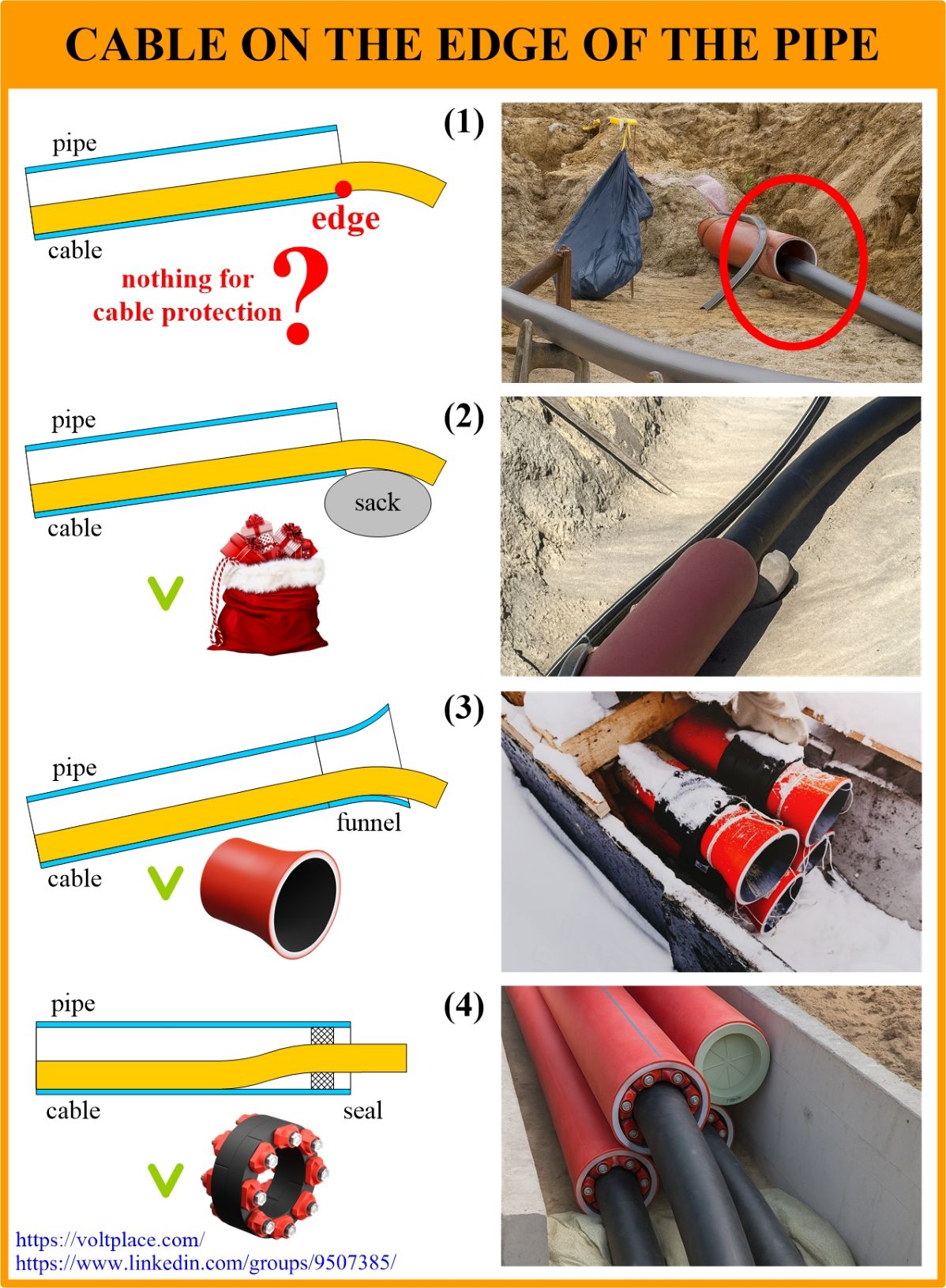
As a result, the cable lays on the sharp edge of the pipe, and over the years, the cable outer sheath may be damaged in this place. Damage to the cable sheath is especially likely in cases where the cables are laid in pipes that have been placed using the HDD method. Why?
Because in this case, the edge of the pipe is the place where the cable rises up (with the pipe) and then reaches the horizontal section (out of the pipe) – that is, the edge of the pipe is a place of cable bending. And this bend is done around the sharp edge of the pipe, not around the roller (there was a roller, but only at the stage of cable pulling).
So, we have 4 main ways to design the end (the edge) of the pipe:
1️⃣❌ do nothing.
2️⃣ place a sack with sand inside (or so-called “sandbag”);
3️⃣ install a funnel;
4️⃣ seal the pipe with an O-ring seal.
Option 1️⃣ is unfavourable, and it becomes even dangerous in the case of HDD. Options 2️⃣,3️⃣,4️⃣ are always good and may be used separately from each other or in different combinations. For example, we can have 2️⃣+3️⃣ or 2️⃣+4️⃣ or even 2️⃣+3️⃣+4️⃣.
But sandbag 2️⃣ is always a good thing to have! Not only as a New Year present!
AFTERWORD
There are manufacturers of high-quality seals in the world. They call the main functions of their products:
✅ protection of the pipe itself from penetration of water and dirt into it;
✅ protection of basements/chambers, where pipes enter, from the penetration of water and dirt coming from pipes;
✅ protection from rodents and termites;
✅ protection against the spread of gas;
✅ protection against the spread of fire;
We may suggest another feature to add to this list:
✅ protection of the cable from touching the sharp edge of the pipe (that is 4️⃣).
It is written in the 12th part of the book “High Voltage cable lines“.