
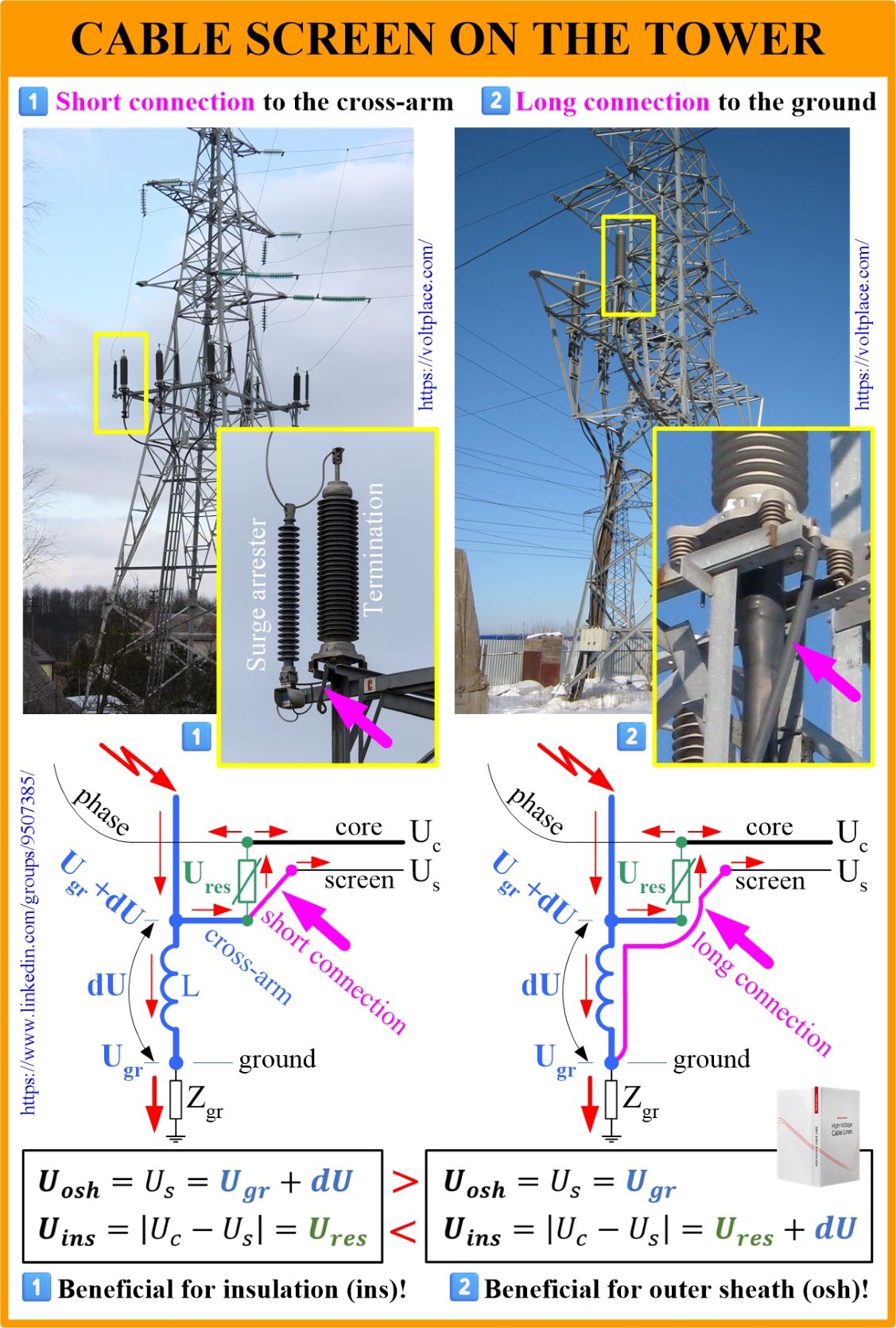
Cable screen on the transition tower
There are many mixed lines, consisting of cable and overhead sections. Let us talk about transition towers and try to figure out how best to connect the cable screen there. Two options are possible for the screen to be grounded:
1️⃣ short path – to the metal crossarm of the tower;
2️⃣ long path – to the ground, by an insulated bonding cable that passes down to the ground level.
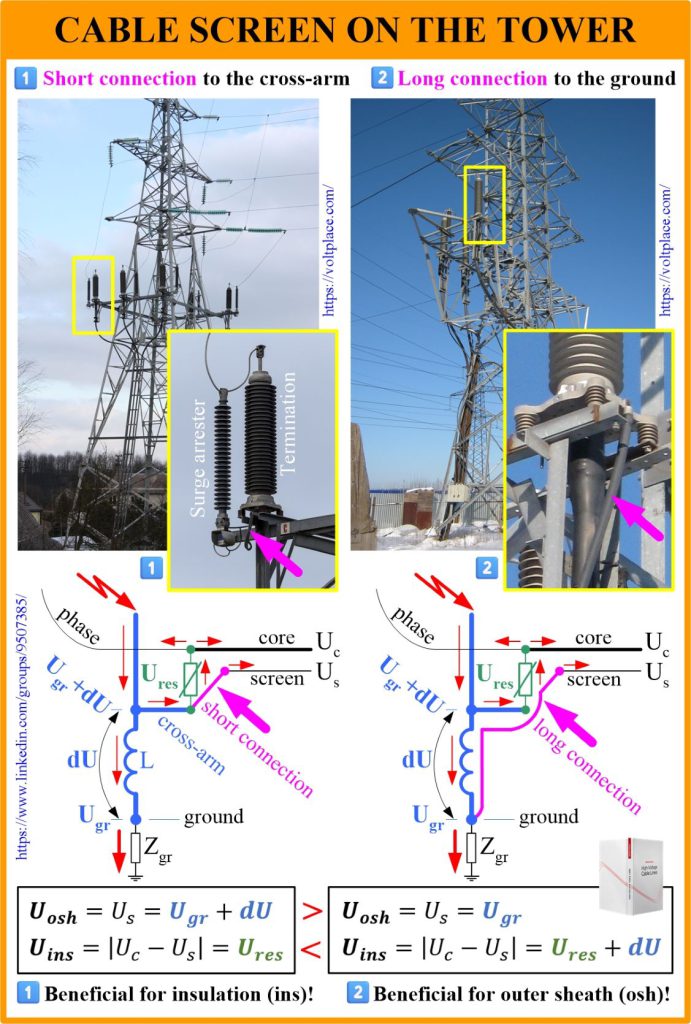
For simplicity we will assume that this is exactly the transition tower on which it was necessary to do a grounding of the screens, and sheath voltage limiters (SVL) are not installed at this tower (if we need SVLs, they would add ~20kV of impulse voltage drop to the grounding of the screens, for any of 1️⃣/2️⃣).
We will also not talk about the fact that the outer sheath of cables must be periodically tested with DC 10kV, and during such tests the screen must be ungrounded, and it is more convenient and safer to do this for option 2️⃣.
So, putting aside SVL and testing by DC, what do we have left? It turns out that in the case of a lightning strike into the top of the tower, options 1️⃣ and 2️⃣ differ significantly from each other in terms of impulse voltages:
✅ Uins – on the insulation (the voltage between the core and the screen);
✅ Uosh – on the outer sheath (the voltage between the screen and the ground, but the ground is not directly at the tower, which has Ugr>0 potential, but slightly to the side, where the ground potential is about 0).

The problem lies in the fact that the lightning current, passing through the body of the tower from the top to the ground, creates a voltage drop dU = L*di/dt on the inductance L of the section of the tower between cross-arm and the ground. The linear inductance of the tower is about 1µH/m, and then, if it is 10m from the cross-arm to the ground, then the inductance of this vertical section can be estimated as 10µH. The rate di/dt of change of the lightning current varies significantly, but it can easily reach 50kA/µs (at the front). Then the voltage drop is dU=10µH*50kA/µs=500kV, that is, it can be hundreds of kV.
The difference between options 1️⃣ and 2️⃣ is where this dU voltage is added – to the insulation or to the outer sheath:
1️⃣ dU is added to the voltage on the sheath.
2️⃣ dU is added to the voltage on the insulation.
According to IEC 60840, for cables of 110-161kV classes (for which transition towers are quite common), it is acceptable to have the following peaks of the lightning impulses:
✅ 550-750kV for the main insulation;
✅ 37.5kV for the outer sheath.
The residual voltage of 110-161kV surge arresters is Ures=200-300kV, and thus it is clear that, if we need to choose, it is better to add hundreds of kV of voltage drop dU not to to the sheath (option 1️⃣) but to the insulation (2️⃣).
So, option 2️⃣ is more rational (regardless of SVLs). Option 2️⃣ will become even more attractive if we take into account issues of the sheath tests by DC.
AFTERWORD
For high voltage 110-161kV lines, option 1️⃣ is dangerous because it cannot ensure that the cable outer sheath is exposed to voltages less than 37.5kV. However, it is interesting that option 1️⃣ is typical for many transition towers on medium-voltage 6-35kV lines, where the design of the transition tower is usually so simple that no one wants to deal with long insulated bonding cables for screen connection to the ground level. It seems that for such transition towers, a lot of damages to the cable sheath are expected (not only due to the absence of insulated bonding cables, but also due to the fact that, according to IEC 60840, outer sheath of 35kV cables withstand only peaks of 30kV, and not of 37.5kV typical for 110-161kV cables).
In the Part 9.2 of the book “High Voltage Cable Lines” you will find arguments about:
✅ the fact that the actual strength of the sheath is, of course, higher than 30-37.5kV, and can reach 100kV or more;
✅ what can be the peak of the voltage Ugr, and why Earth Continuity Conductor (ECC) doesn’t help on lightning processes;
✅ what the requirements for the grounding impedance of the transition towers should be (impedance Zgr shown in the diagram).