
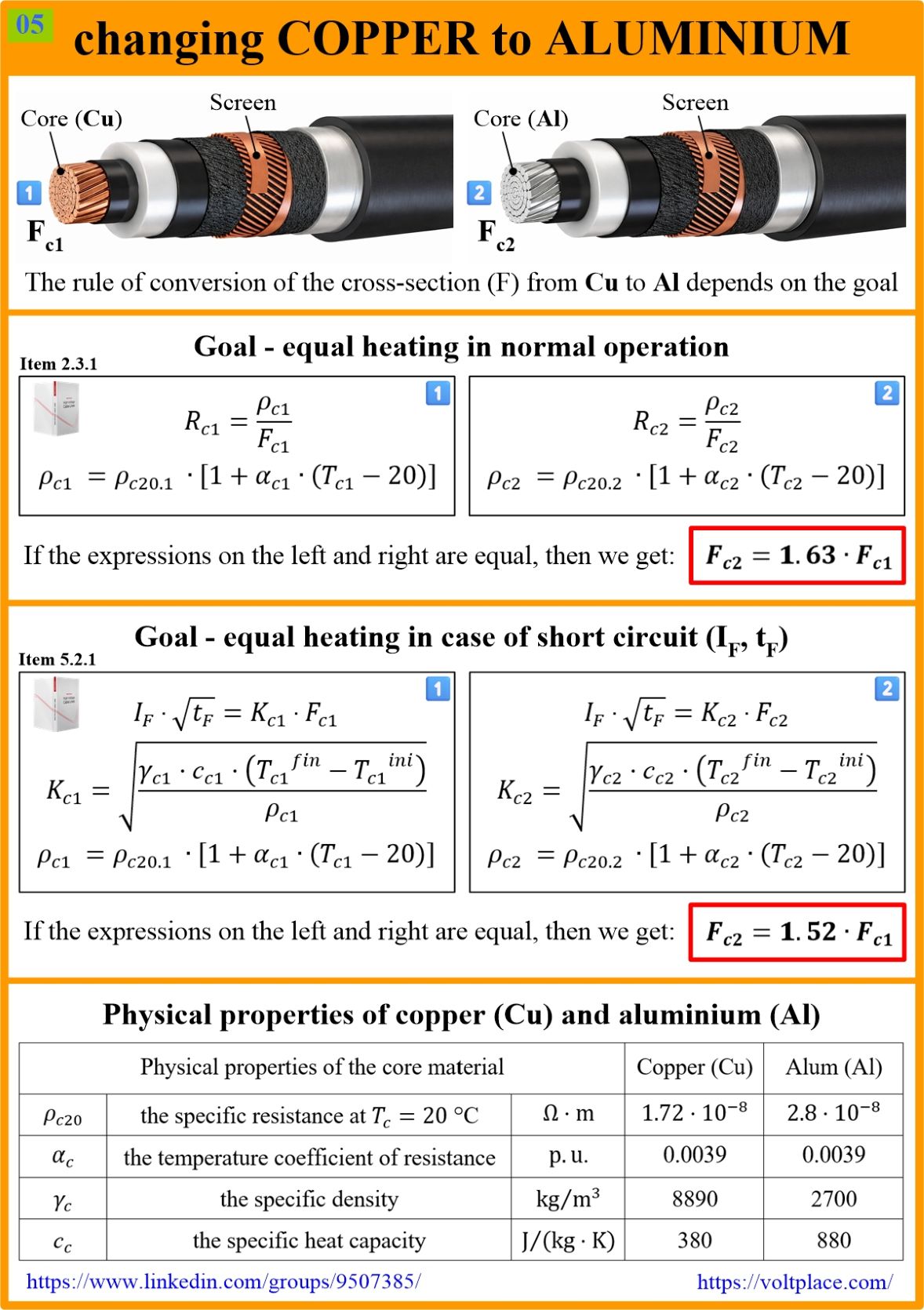
Changing copper conductor to aluminium
Copper (Cu) and aluminium (Al) are the two main materials for the manufacture of conductive elements (cores and screen) of cables of all voltage classes. When choosing between Cu and Al, we have to compare them, and not in words, but numerically.
For example, we know at least the following numbers comparing the properties of Cu and Al, which may be conditionally divided into advantages of Cu (✅) and disadvantages of Cu (❌):
✅ Cu has an electrical resistivity that is about 1.6 times less than that of Al (1.72 versus 2.8);
✅ Cu withstands pulling forces about 1.7 times greater than that of Al (50 versus 30 N/mm2);
❌ Cu is almost 3 times heavier in weight than Al (8890 versus 2700 kg/m3);
❌ Cu is up to 3-4 times more expensive than Al.
Without considering the issues of pulling forces and price, but relying only on the cable’s ability to pass electric current, let us evaluate what the rule for the express conversion of the copper cross-section into the aluminium cross-section might be. It turns out that the recalculation rule depends on which current we are talking about – normal operation or short circuit.
➡️ Rule for normal operation.
The conversion rule can be obtained based on the assumption that the active resistances of Cu and Al should be equal, producing the same heat. If we do not take into account such things as the different degrees of skin-effect for Cu and Al, then we get that the cross-section of the Al conductor should be about 1.6 times larger than the Cu one.
➡️ Rule for short circuit.
The conversion rule depends, for example, on the density and heat capacity of the materials. If we do not take into account the cooling of the conductor during the short circuit (assuming the processes are adiabatic), then we get that the cross-section of the Al conductor should be about 1.5 times larger than the Cu one.
When should each of these two rules (1.63 and 1.52) be applied?
♨️ The normal operating mode is more important for a core, and therefore the “1.6-fold rule” is more likely there (although, of course, then a detailed thermal calculation should be carried out and the cable line ampacity checked, taking into account all the influencing factors, one of which is obvious – a larger cross-section, less thermal resistance of insulation and soil);
♨️ the short-circuit mode is more important for a screen, and therefore the “1.5-fold rule” is more likely there (since screen cross-section is usually several times less than that of the core, and short-circuit current pose a danger primarily to screen, and not to core).
So, we see that the rule for converting copper (Cu) to aluminium (Al) depends on the problem being solved. For a quick estimate, based on the ability to pass electric current, we can use approximate coefficients:
👉 1.63 (normal operation);
👉 1.52 (short circuit).
Note. The screen cross-section selected according to “rule 1.5” (short circuit) will provide a higher active resistance of the screen compared to “rule 1.6”. Therefore, in normal operation, if the screens are solidly bonded, then in the case of “rule 1.5” they will have lower circulating currents (these currents are limited by increased resistance of the screens) and less heating which gives a higher ampacity of the cable line. We can see that “rule 1.5” is advantageous for the screen for many reasons.