
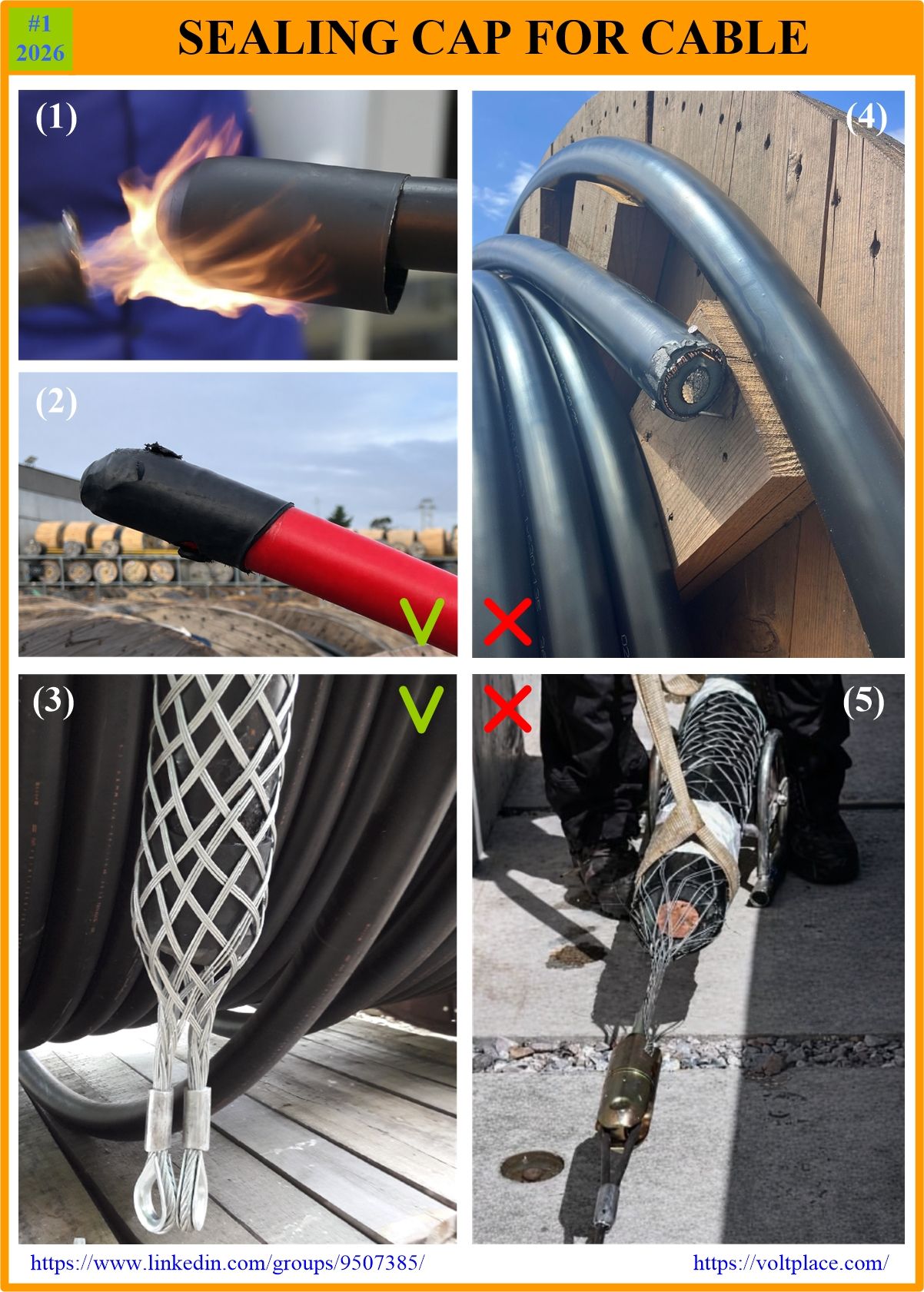
Sealing cap for cable
For modern cables of 6-500 kV voltage classes, cross-linked polyethylene (XLPE) insulation is the most common. The properties of XLPE are such that if water molecules penetrate the insulation, they become a source of electric field distortion there, which contributes to the development of insulation defects called “water trees”. The appearance of water inside the insulation can lead to its breakdown in just a few years of operation. If the water was able to spread along the cable, then numerous defective spots should be expected, and, in fact, a complete replacement of the cable section will be required.
Considering the above, special attention should be paid to the protection of insulation from water at all stages of the cable lifecycle. For example, it is required:
🔹 dry the raw materials used in the manufacture of cables;
🔹 add elements to the cable structure aimed at preventing water from entering the cable, that is, they make transverse sealing (polymer sheath, alum-polymer tape, corrugated Al-sheath);
🔹 add elements to the cable structure aimed at blocking any spread of water along the cable if it has already got there (water-blocking tapes and yarns);
🔹 cover the cable ends with sealing caps.
Normally, the sealing caps are heat shrinkable, as shown in photo 1️⃣. In the cable lifecycle, it is allowed to remove the sealing cap only in the following cases:
👉 during cable testing (at the factory or at the facility);
👉 during the installation of the cable joints and terminations.
Le us look at the following photos:
2️⃣ The cable on the drum is protected by the cap ✅.
3️⃣ The cable prepared for pulling along the route is protected by the cap ✅.
4️⃣ The cable is stored on the drum without a cap ❌.
5️⃣ The cable is pulled along the route without a cap ❌.
Options 2️⃣-3️⃣ are safe for the cable, while 4️⃣-5️⃣ can lead to water penetration into the insulation and subsequent problems for the cable. In some cases, the absence of a cap on the cable may cause the cable to have no future. That is, it makes useless the work of dozens of our colleagues in the cable industry. Let us think about these people every time we leave the cable unprotected by sealing caps.