
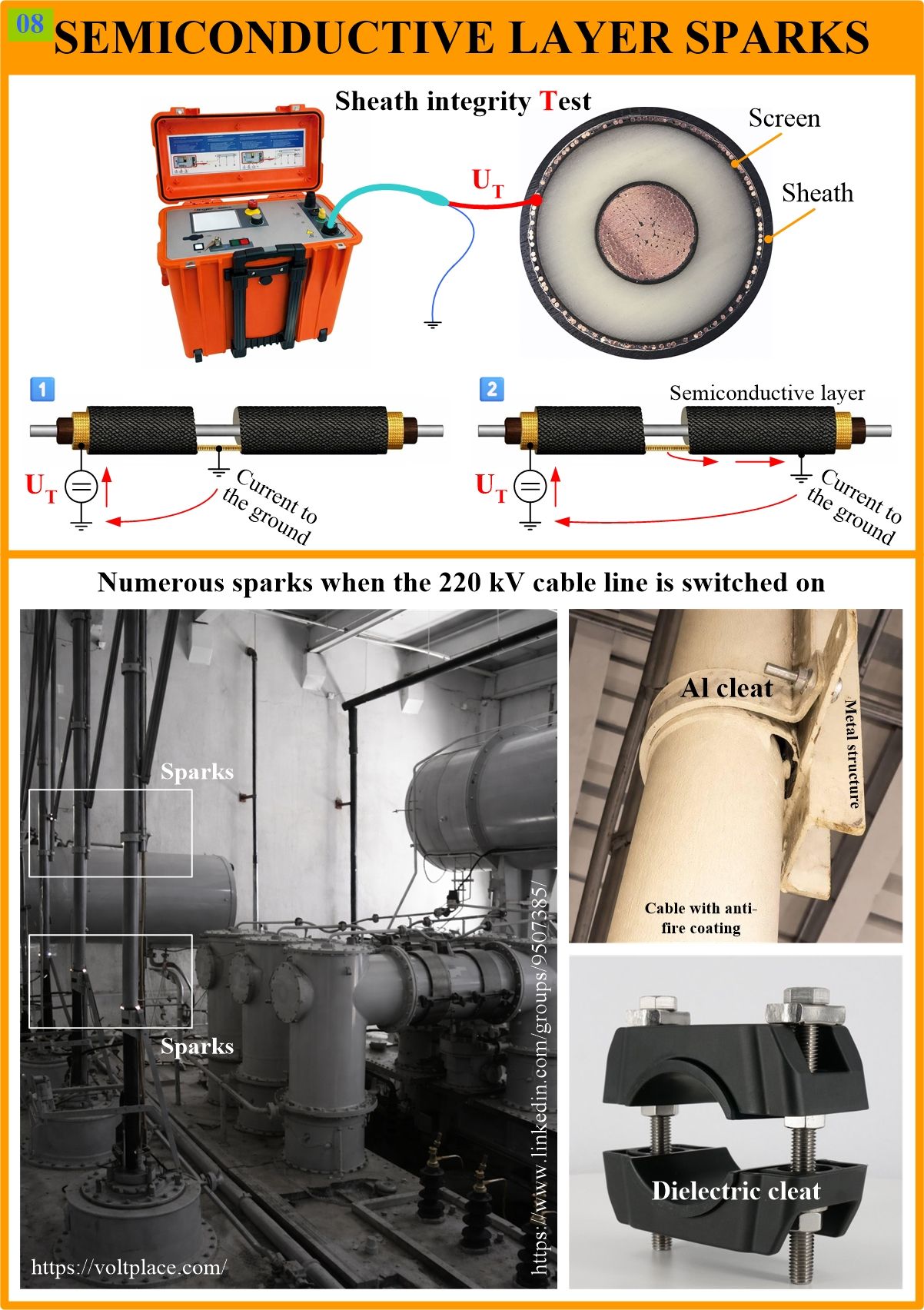
Semiconductive layer over the cable
The sheath of high-voltage cables sometimes has a semiconductive layer (SC). Such a layer is believed to allow for better control of the condition of the outer sheath of the cable. For example, the presence of such a layer allows to check the cable outer sheath while the cable is on the drum. For this, it is enough to apply a test voltage Ut between the cable metal screen and the SC layer and make sure that no current occurs. However, today let us focus on testing the cable that has already been laid.
After laying the cables, it is important to remove the SC layer from the cable sheath at the ends of cable sections (in terminations and joints), in order to separate the SC layer and the metal screen of the cable, and to eliminate overlaps between them during sheath tests. Thus, if we want to test the sheath of the entire cable after its installation, then the application of voltage between the screen and the SC layer no longer makes much sense, since the SC layer receives many breaks (in joints) along the route of the cable line. So, it is better to apply Ut not between the screen and the SC layer, but between the screen and the ground, as shown in the diagaram.
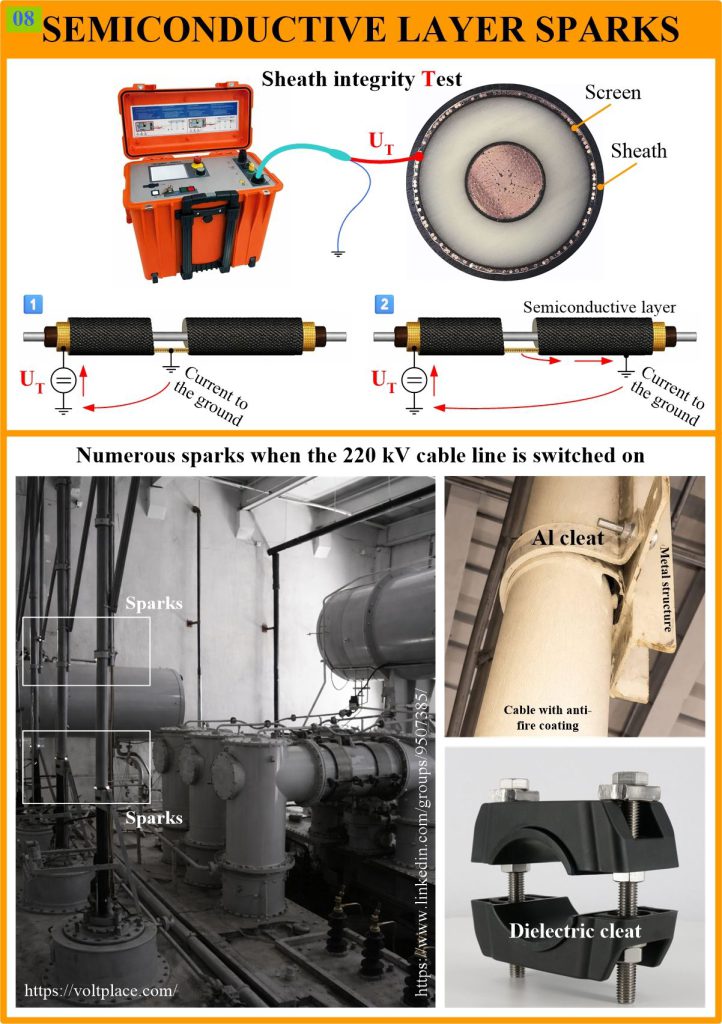
Let us look at two scenarios of the sheath test:
1️⃣ The cable has many contacts with the “ground” (soil or grounded structures).
2️⃣ The cable has few contacts with the “ground” which is typical for laying:
🔹 in dry ground,
🔹 in the air,
🔹 in polymer pipes.
For 1️⃣, the current passes to the ground at the point of damage to the sheath. For 2️⃣, the current goes out where there is contact between the SC layer and the ground – in this place, overheating of the SC layer may occur due to current associated with testing the sheath and the subsequent locating for a place of damage. Thus, theoretically, the first damage to the sheath may provoke a new damage to the sheath in an initially undamaged place.
Sheath testing and damage locating are not the only situations where SC can create surprises. In general, problems can occur in three cases:
👉 sheath testing / damage locating;
👉 line switching;
👉 normal operating mode.
Today, let us give an example of switching. The photo shows the moment when the 220 kV cable line is switched on. Also you can watch the video. Numerous sparks are visible in the places where the cables are attached to metal structures. These sparks occur between the SC layer and the “ground” and represent flashovers of silicone inserts between the Al cleats and structures. Repeated switching could damage the sheath in these places, and it was necessary to replace the cleats with dielectric ones, which provide better insulation between the SC layer and the ground.
There was another option – not to isolate the SC layer, but rather to ground it well in the cleats. In general case, this would be safer for the personnel, because according to calculations, the switching impulses on the SC layer could reach up to several kV.
Interestingly, similar problems of point damage to the SC layer and sheath can occur not only for cables in the air, but also for cables in the ground in dielectric polymer pipes – at the edges of the pipe sections where the SC layer approaches the conductive soil. However, sparks in this place underground can hardly be noticed, as was in the case of laying in the air, discussed today, when sparks and loud pops revealed the problem at the very first switching on of the line.
In a future, we will give some examples of SC problems in normal operation (today we discussed only testing and switching).
AFTERWORD
The semiconductive (SC) layer on the cable outer sheath is considered an advantage of the cable. However, as we can see, in the general case, this is not a correct statement, and the SC layer can cause serious damage to the cable. It means that the regulatory documents should specify under what conditions the use of a SC layer on the cable is safe for the cable (and for people). At the same time, to be honest, I don’t remember that these issues were sufficiently covered in IEC, IEEE, CIGRE.