
Single-point bonding of cable screens
Single-core cables are used in both high-voltage and medium-voltage (MV) networks. In both cases, the cables have the same problem – the presence of induced (circulating) currents in solidly bonded screens. To solve the problem, there are other bonding types:
👉 Single-point bonding of the screens.
👉 Cross-bonding of the screens.
Despite the fact that problem with currents in the screens is typical for any single-core cables, regardless of their voltage class, these measures are primarily used only for 110-500 kV cable lines, and in 6-35 kV cable lines, on the contrary, it is common to have solid bonding of the screens. This attitude towards 6-35 kV lines is incorrect, and there are several explanations for this practice:
❌ When choosing a screen bonding type, the main focus is on ampacity, and the cost of losses in the screens is ignored.
❌ It is considered that in case of rejection of the solid bonding of the screens, link boxes with surge arresters (sheath voltage limiters, SVL) installed in them are necessarily needed for 6-35 kV lines.
❌ It is believed that single-point bonding of screens, as for 110-500 kV lines, can only be used for very short lines up to 500 m long (without an earth continuity conductor, ECC) or up to 1000 m long (with ECC).
The book provides detailed explanations on each of these points. So, when choosing a bonding type for 6-35 kV cable screens:
✅ The cost of losses in screens is no less important than the ampacity of the cable line. In other words, single-point bonding of the screens is not only a way to increase the ampacity of the line, but also a way to eliminate losses in the screens and save on their cost (sometimes the effect can be tens of thousands of euros per year or hundreds of thousands of euros for the service life of the cable line).
✅ SVLs are not needed for 6-20 kV lines (even for 35 kV lines).
✅ In 6-35 kV networks, ECC does not help to reduce the induced voltage on the screen (since a single-phase short circuit is not a case), but, despite this, single-point bonding of screens can be safely used for lines up to 2-3 km long (which is several times longer than for 110-500 kV lines).
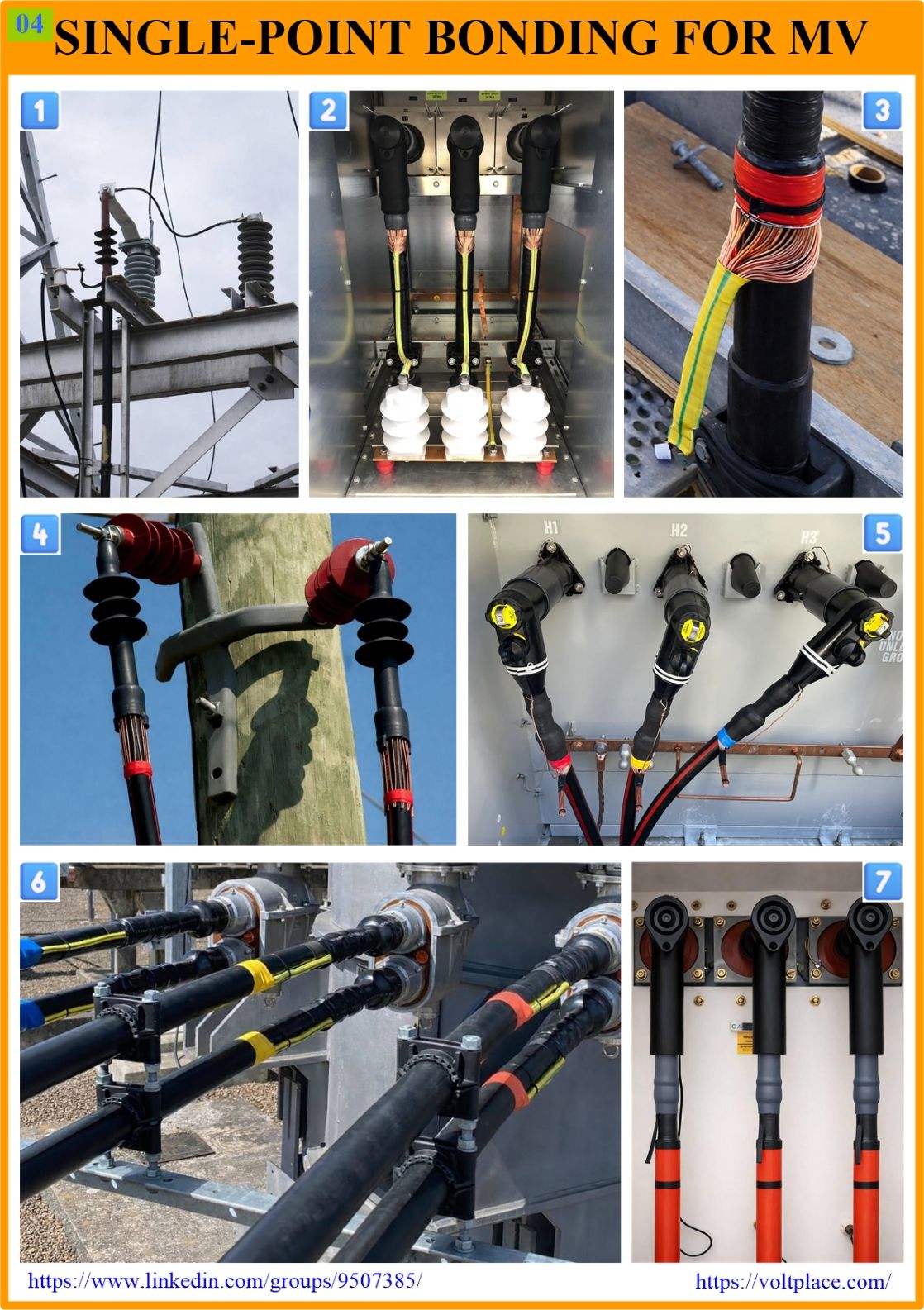
Considering the above, single-point bonding of screens becomes very attractive and profitable for many 6-35 kV lines. The photo shows the options for its implementation in practice.
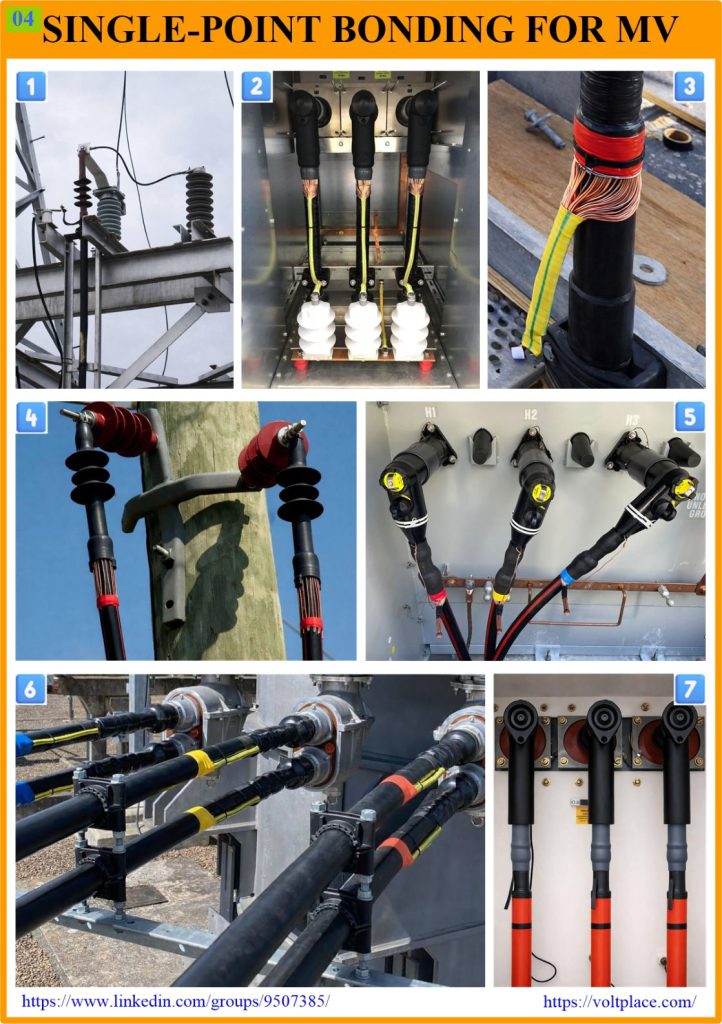
Options with SVLs (however these SVLs are not needed for medium-voltage cable lines):
1️⃣ Transition tower of 35 kV, where the screen is removed from the termination and connected via a support insulator to a bonding cable that goes down along the tower body to a link box with SVLs installed there.
2️⃣ Cable compartment, where the SVLs are installed without link box.
Options without SVLs, and with easy access to the screen (important for connecting instruments for cable testing and fault locating):
3️⃣ The screen is partially covered by a heat shrink.
4️⃣ The screen is bare, at a height on the transition pole.
5️⃣ The screen is bare, in the cable compartment.
Options without SVLs, with a screen that is covered with insulating materials, which, however, can be easily removed if necessary, providing access to the screen:
6️⃣ Connection to gas-insulated switchgear (GIS).
7️⃣ Cable compartment.
As we can see, there are many ways to make single-point bonding of screens for medium voltage cables. The idea of the post is simple – to show that there is no need to be afraid of single-point bonding of screens in medium-voltage cables. It can be done much easier and cheaper than in high-voltage cables.
For more information, it is recommended to read the following sections of the book “High Voltage Cable Lines”:
👉 Limiting length for single-point bonding – Part 3.
👉 Cost of power losses in the screens – Part 3.
👉 Earth continuity conductor (ECC) along the line and its effect – Part 4.
👉 Sheath voltage limiter (SVL) – Part 10.