
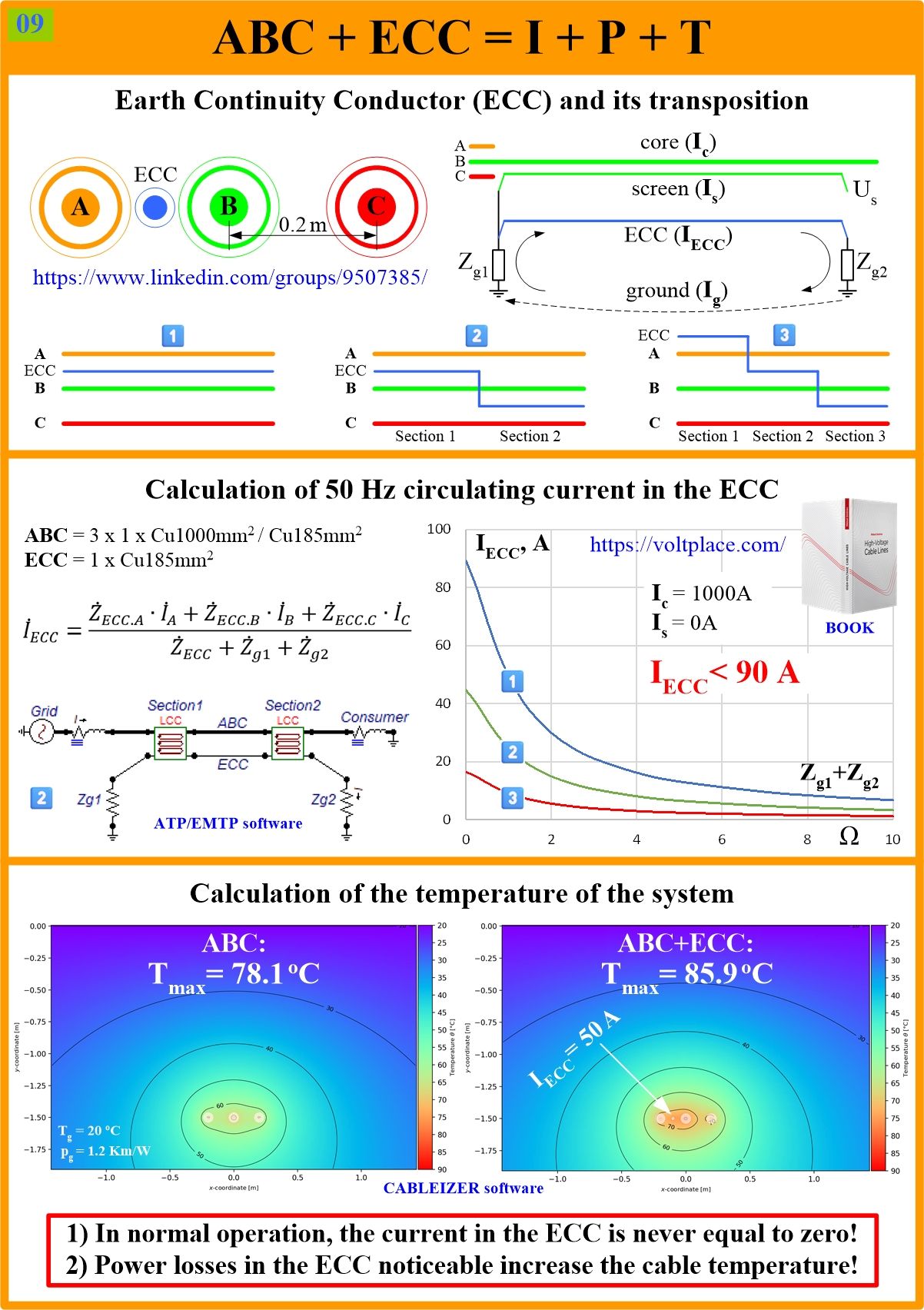
The effect of ECC on the cable line
Today, let us talk about the Earth Continuity Conductor (ECC) and the bad things it does to the cable line during normal operation. ECC is most often used for cable lines made with single-core cables and having single-point bonding/grounding of the metal screens. ECC performs two main functions:
✅ ECC reduces 50 Hz voltages (Us), which are induced in the screens by the core current of non-symmetrical short circuit external to the cable line.
✅ ECC provides connection of the groundings at the ends of the line, which may be necessary for safety and electromagnetic compatibility issues.
Suppose, we have cables ABC and somewhere between them or next to them we need to place an ECC. For example, if cables ABC are laid in three pipes, then a separate (fourth) pipe for the ECC may be required. However, today let us look at a simpler option – laying cables in a row. In normal operation, by the magnetic field of core currents, a 50 Hz current (Iecc) is induced in the contour formed by the ECC and the ground. The current (Iecc) causes power losses (Pecc) in the ECC and extra heating of the entire cable system.
The magnitude of the ECC current (Iecc) can be reduced if the ECC changes position relative to cables ABC – that is, a “transposition” is made. Let us look at three cases:
1️⃣ ECC is not transposed (no changing of ECC position).
2️⃣ ECC changes its position only once (two sections).
3️⃣ ECC changes its position two times (three sections).
For example, let us take a 110 kV line with single-point bonding/grounding of the screens and with a distance between the axes of the cables equal to 0.2 m. The calculation of the ECC current (Iecc) in cases 1️⃣-2️⃣-3️⃣ can be done in two ways, which give the same result shown in the graph:
👉 using book (formulae from Part 4).
👉 using EMTP (the case 2️⃣ is shown).
The graph shows that with a 1000 A current (Ic) in cores ABC, the induced current (Iecc) in the ECC can reach 90 A, but even in the case of a full transposition 3️⃣, the current does not decrease to 0. To show the consequences, let us perform a thermal calculation of the cable line for the following options:
👉 without ECC.
👉 with ECC (the ECC current was set as 90 A, assuming that the groundings Zg1 and Zg2 do not limit the current).
The thermal calculations were performed using the Cableizer software, which was kindly provided by Damian Aegerter, and show that the presence of the ECC increased the temperature of the cables from 77.6℃ to 78.3℃, that is by 0.7℃.
So, today using different calculation methods, we have come to conclusions:
✅ The ECC transposition does not reduce the current in the ECC to zero.
✅ ECC is able to increase the temperature of cables by up to 1°C (or even higher, if there are two ECCs in parallel), however, thermal calculations according to IEC 60287, which are done all over the world, usually mistakenly ignore ECC.
AFTERWORD
Usually, we have great confidence in the IEC 60287 thermal calculation method, considering it to be very accurate. However, even with IEC 60287, we still get incorrect results. And not because the IEC 60287 formulas are bad (they are good!), but because we don’t take into account some of key inputs. Ignoring ECC will lead to inaccuracy in thermal calculations and underestimating the temperature of the cables.