
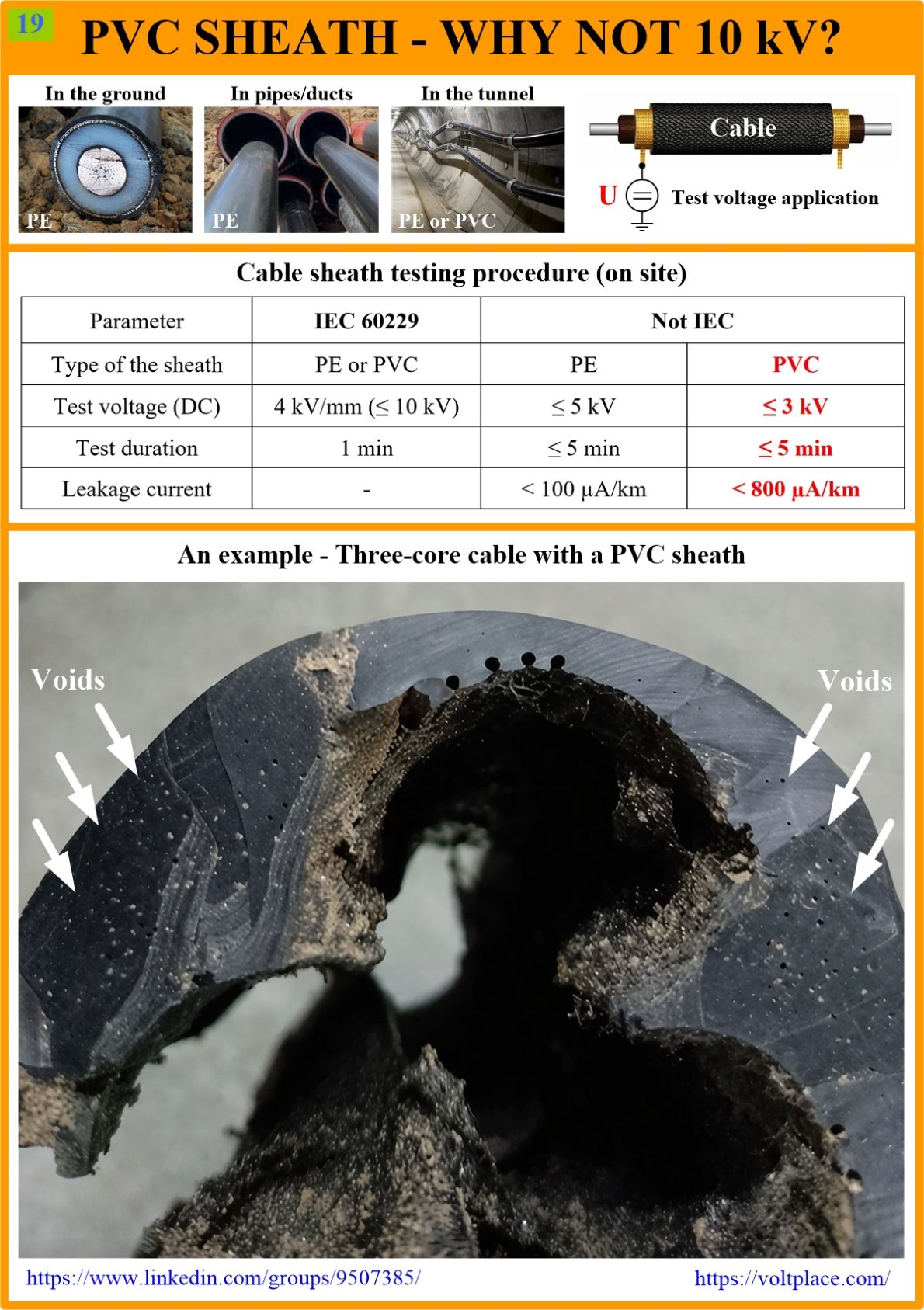
Cable with PVC sheath
Both polyethylene (PE) and polyvinyl chloride (PVC) are widely used in the production of the outer sheath of cables. The cost of PVC sheaths is usually less than that of PE, but a direct price comparison hardly makes sense, because sheaths made of these materials have different applications:
✅ PE is quite resistant to moisture, but at the same time has a high flammability.
✅ PVC absorbs water well, but it has a low flammability.
These differences between PE and PVC, as well as a number of others, led the cable industry to the following separation of the fields of application of the two materials:
➡️ PE sheath is more used for laying cables in the ground.
➡️ PVC sheath is more used for laying cables out of the ground (indoors, in tunnels etc.).
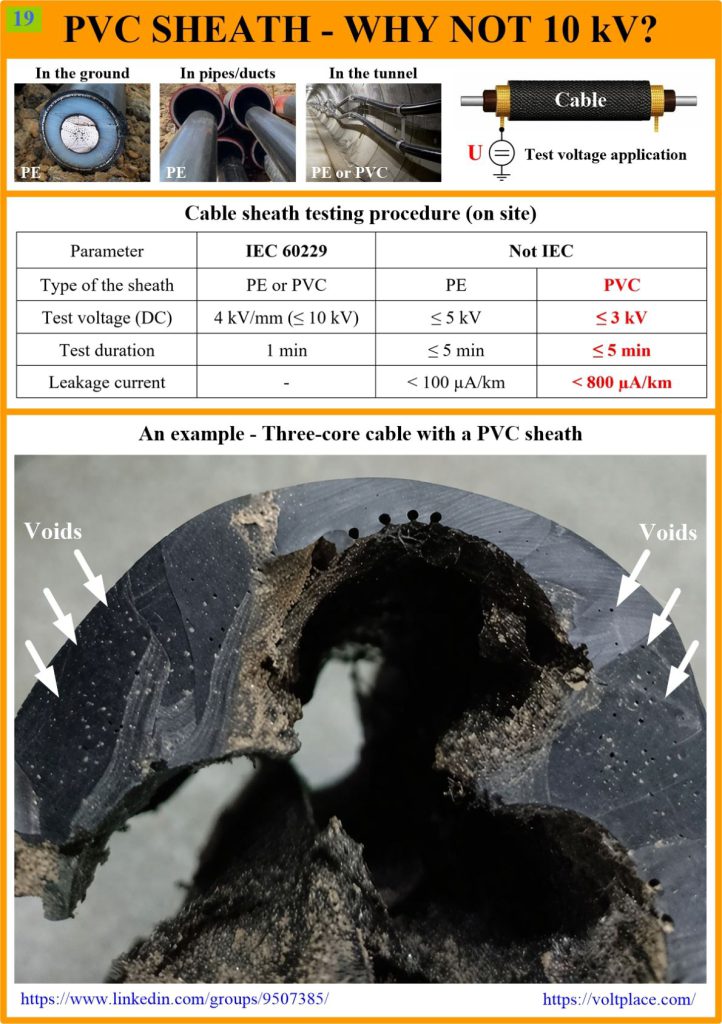
For some reason, PVC is more common for low-voltage and medium-voltage cables. As for high-voltage cables of 110-500 kV classes – instead of PVC, it’s more typical there to have more expensive sheath of so-called “polymer composition” which has not only a low flammability (as PVC) but also a high resistance to moisture (as PE).
However, let us talk about something else. According to IEC 60229, on site, all types of sheaths (PE, PVC, polymer composition, etc.) are tested equally with DC 10 kV, as shown in the table. At the same time, we can find a number of documents (for example, presentations of suppliers of equipment for testing cables), where completely different figures are given.
For example, the sheath of 6-35 kV cables is recommended to be tested not with DC 10 kV but with:
✅ DC 5 kV, for PE sheath.
✅ DC 3 kV, for PVC sheath.
Despite IEC 60229, the permissible leakage currents are also indicated, and they are much higher for PVC. What is the reason for all of this? This is due to the fact that, according to operational experience, PVC easily absorbs water, and, in some cases, it is not possible to raise the voltage to 10 kV or even just 5 kV due to significant leakage currents. At the same time, the sheath is not damaged, has not lost its integrity.
Such properties of PVC “to be as a sponge” are due to the fact that it has a porous structure, as shown in the photo. Hence the suggestions:
➡️ Reflect in IEC the experience gained on PVC (to give people a legitimate reason not to try to raise the voltage to DC 5-10 kV, but to limit the test voltage to DC 3 kV).
➡️ Think twice before using PVC-sheathed cables under conditions of high humidity, such as damp tunnels etc. (it may turn out to be impossible there to test the cable sheath even with a voltage of DC 3 kV).
➡️ Do not store PVC-sheathed cables outdoors.
You can discuss this post on LinkedIn, in the “High Voltage Cable Lines” group, by following the link to the post.