
Backfilling of cable joints
Let us talk about high-voltage (HV) and extra-high voltage (EHV) cables lines. Joints of these lines are usually placed not in the open ground, but in reinforced concrete structures (troughs, chambers). There are two main options for action after installing the 220-550 kV cable joints:
➡️ leave structures unfilled, with air inside;
➡️ backfill structures, for example, with sand or a sand-gravel mixture.
Without backfilling, there are at least the following risks:
❌ the possibility of unauthorized persons, including vandals, reaching the cables/joints;
❌ the possibility of a significant increase in pressure inside the chambers in the event of a short circuit in the cables/joints, followed by the release of gases from inside to outside, accompanied with metal cover flight over a considerable distance (I highly recommend watching the short video clip given in the comments to the post).
With backfilling, it would seem, there are no listed risks, and this is good. However, there may be other risks, as shown by photos taken on one of HV/EHV lines.
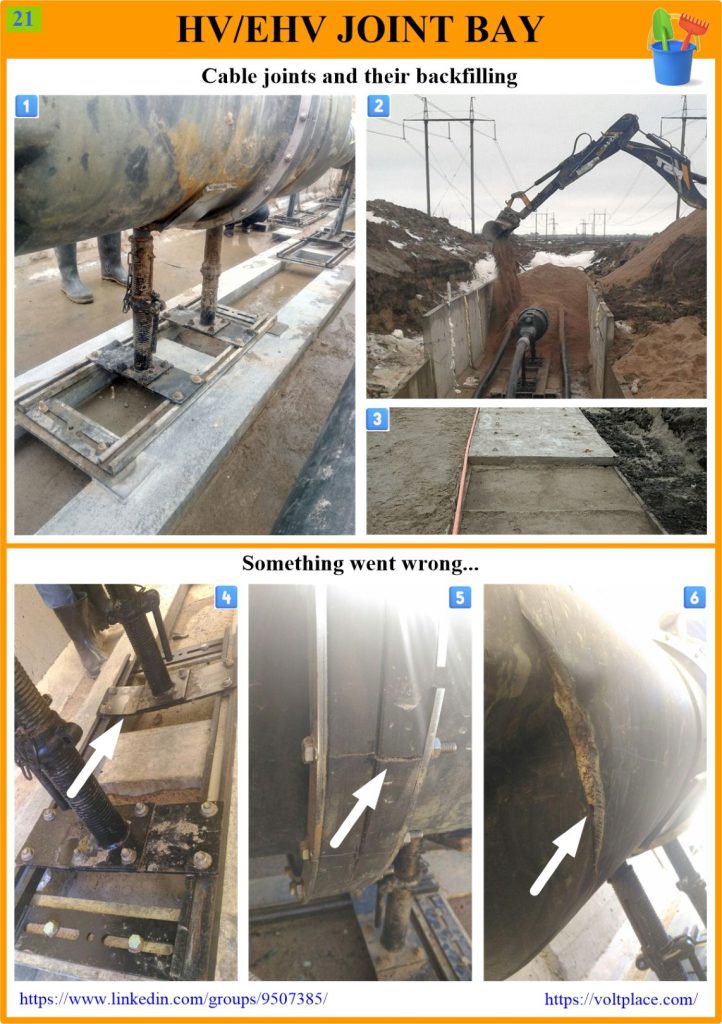
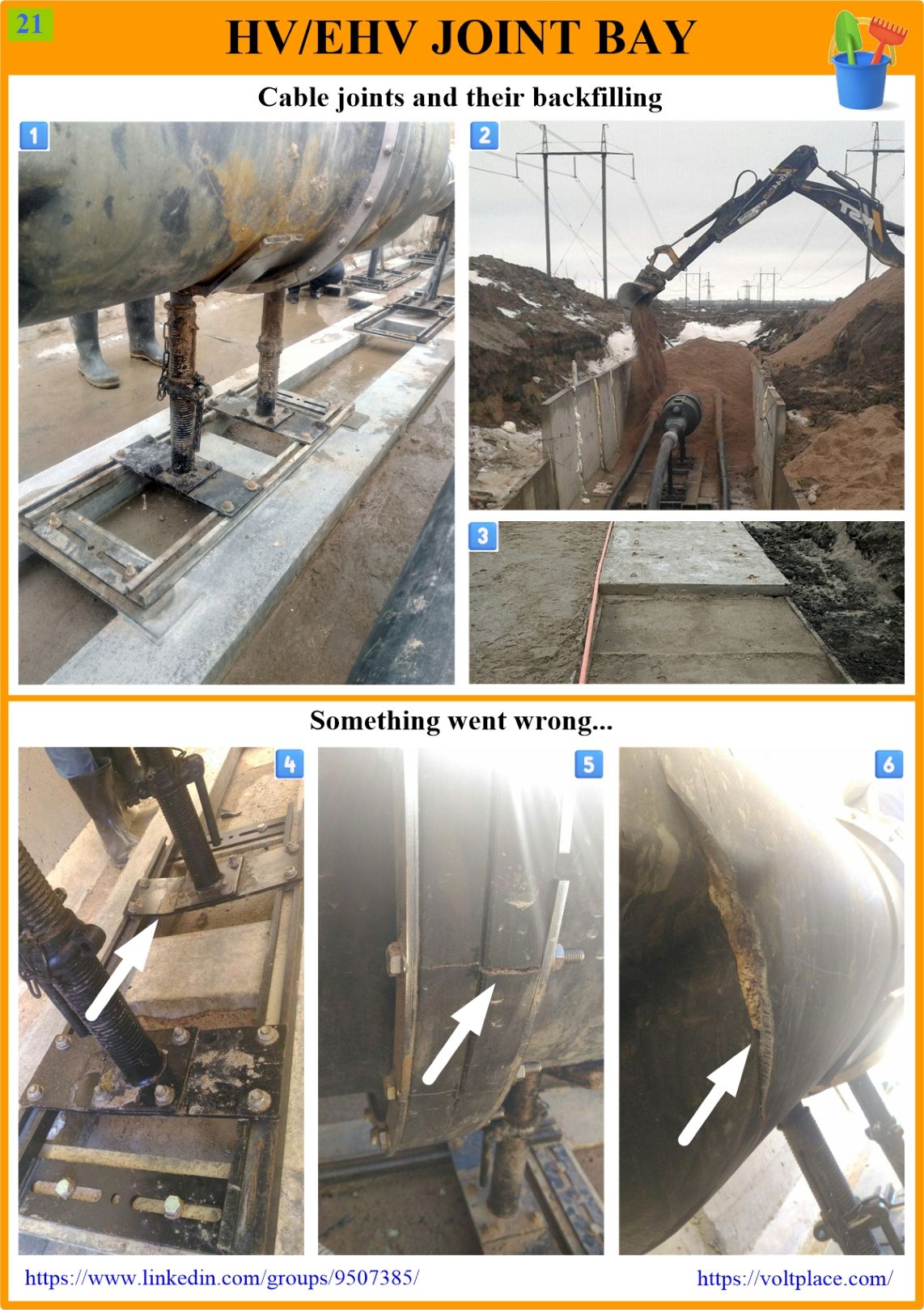
HV/EHV lines, in addition to thick insulation, usually have a significant core cross-section of up to 2500-3500 mm2, and a significant screen cross-section of up to 350 mm2. All factors together lead to the fact that the cable joints have a significant length, diameter, and weight. However, the support structures for the placement of joints are usually point-based. As a result, when filling the joints and installing a protective concrete slab on top, the pressure on the cable joint may be unacceptably high, and joint will crack. Thus, the integrity of the joint will be lost, and this is a nightmare for the entire HV/EHV project.
The photo shows:
1️⃣ support structures for the joint provided by joints’ manufacturer;
2️⃣ filling the troughs in which the joints are installed;
3️⃣ installation of concrete slabs covering the troughs with joints;
4️⃣ deformation of the support structures under the weight of sand;
5️⃣ small crack in the housing of the joint;
6️⃣ massive crack in the housing of the joint.
The question “to backfill or not backfill” sometimes looks similar with “to be or not to be”. The issue is of backfilling a complex one, and it is hardly possible to say that there is any single good universal solution. However, if the decision is made to backfill the joints, it is important:
✅ to be sure that the support structures of the joints will withstand the pressure;
✅ to be patient to backfill carefully, preferably “manually”;
✅ let the slab not touch the backfill (to avoid extra pressure on the joint).
You can discuss this post on LinkedIn, in the “High Voltage Cable Lines” group, by following the link to the post.
AFTERWORD
Please, look at the materials related to “backfilling issue”.
✅ Flying cover of the chamber in the center of the city – Video
✅ Chamber without backfilling, and flying cover – Post
✅ Discussion of the types of joint installations – Post
✅ Consequences of joint installation directly to the ground – Post
HV/EHV cables usually comes with a large core cross-section. The CIGRE working group WG B1.102 deals with the problems of large cross-sections. If you have any interesting cases related to cables with large core cross-section, please send them to me or my collegues from this group. This is crucial for our industry to know all the problems and timely react on them.