Polypropylene cable insulation
Currently, the following types of MV/HV cable insulation are widely known:
1️⃣ XLPE, crosslinked polyethylene (typical for 1-500 kV).
2️⃣ ERP, ethylene propylene rubber (typical for 1-35 kV).
3️⃣ PVC, polyvinyl chloride (in some cases of 1-3 kV).
4️⃣ PP, polypropylene (looking for its place).
Let us talk about the first and last options. Usually, the main advantages of PP compared to XLPE are the following:
✅ PP is designed to operate at temperatures up to 110°C (XLPE has 90°C).
✅ PP is recyclable (XLPE not).
It is important to be able to recycle a new defective cable while it is on the factory. However, if we are talking about recycling old cables that were laid somewhere, then in the case of laying in the ground, old cables often remain permanently buried, since their extraction and transportation are more expensive than the cost of the metals they contain. Therefore, let us put the recycling aside for a separate discussion in the future, and today focus on the temperature of 110°C.
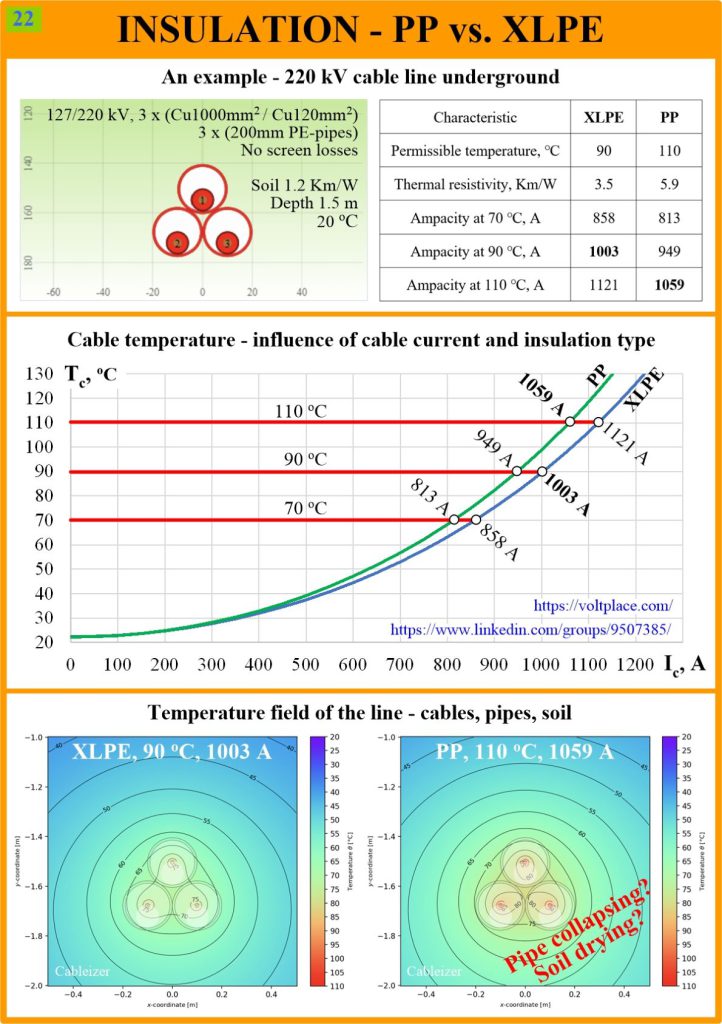
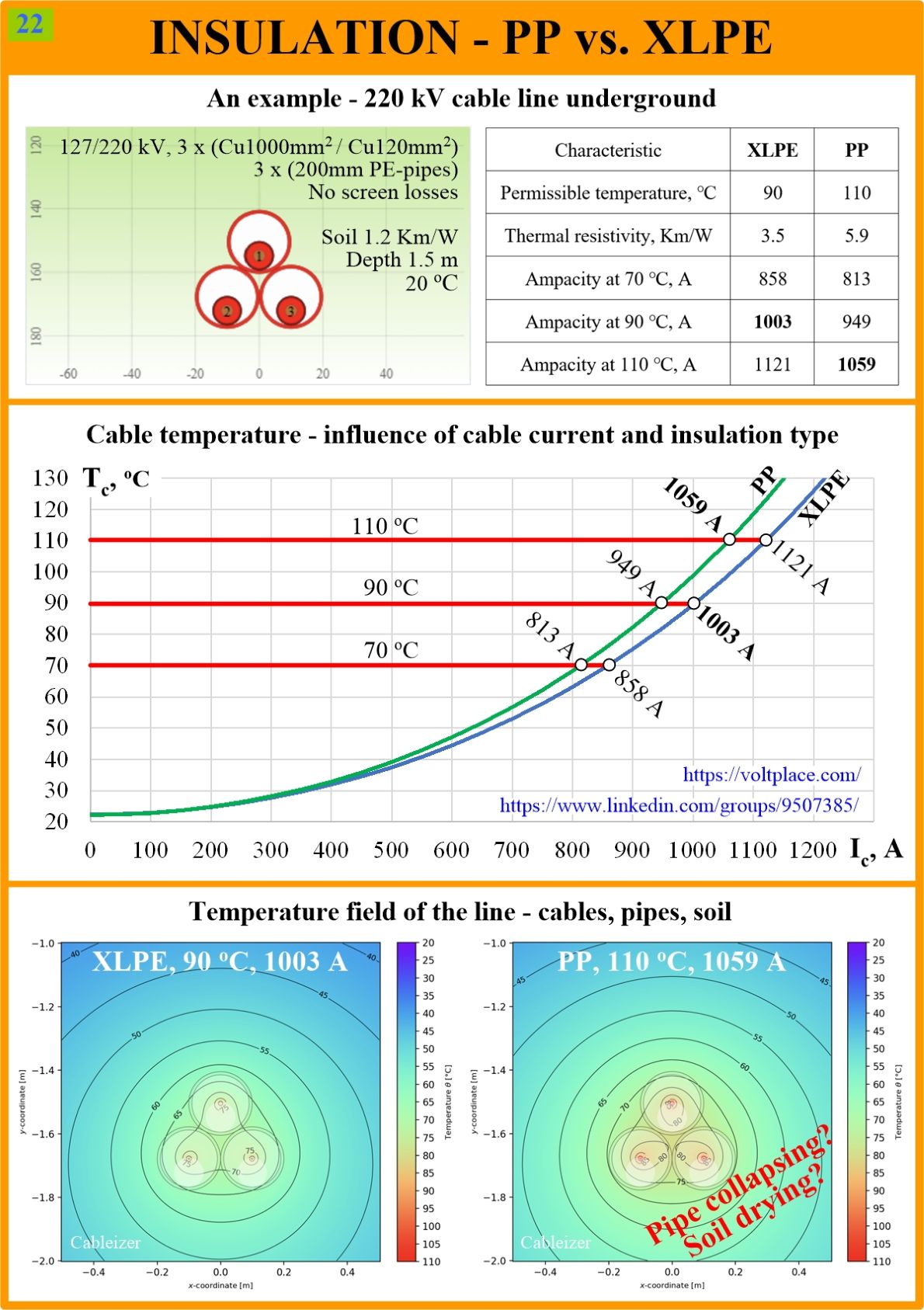
High temperature seems to be a very serious advantage of PP, but let us check this using an example of a 220 kV cable line. The photo shows the results of thermal calculation of the line. It can be seen that we have the following permissible currents:
➡️ for XLPE, at 90°C, the ampacity is 1003 A.
➡️ for PP, at 110℃, the ampacity is 1059 A (+5.6%).
Although the permissible temperatures differ significantly, the permissible current has increased by only 5-6%. This happens for two reasons:
👉 the thermal resistivity of PP is almost 1.7 times greater than that of XLPE, which prevents the cooling of the core of cables with PP insulation.
👉 cable losses are proportional to the square of the current, and at limiting temperatures even a small increase in current results in a significant increase in heating.
OK, we got these extra 5-6% of PP compared to XLPE. But at what cost? As can be seen from the picture of thermal fields:
♨️ the temperature of the soil has increased by 5°C, and this can lead to its drying out, i.e. an uncontrolled avalanche-like increase in its thermal resistivity and cable temperature, resulting in the damage of the entire line.
♨️ the temperature of the pipes has increased by 10°C and reached 70-80°C, and there are essentially not so many cable pipes on the market that can withstand such temperatures, which means that the pipe will collapse, and the cable will be buried, without any possibility to be recycled in the future.
Hence the question – do we really need 110°C? If we don’t need 110°C, and it is quite enough and safe for us to have 90°C (or even 70°C), then it can be seen (from the table or graph) that XLPE-insulated cables have a higher ampacity (compared to PP), due to the low thermal resistivity of the insulation.
You can discuss this post on LinkedIn, in the “High Voltage Cable Lines” group, by following the link to the post.
AFTERWORD
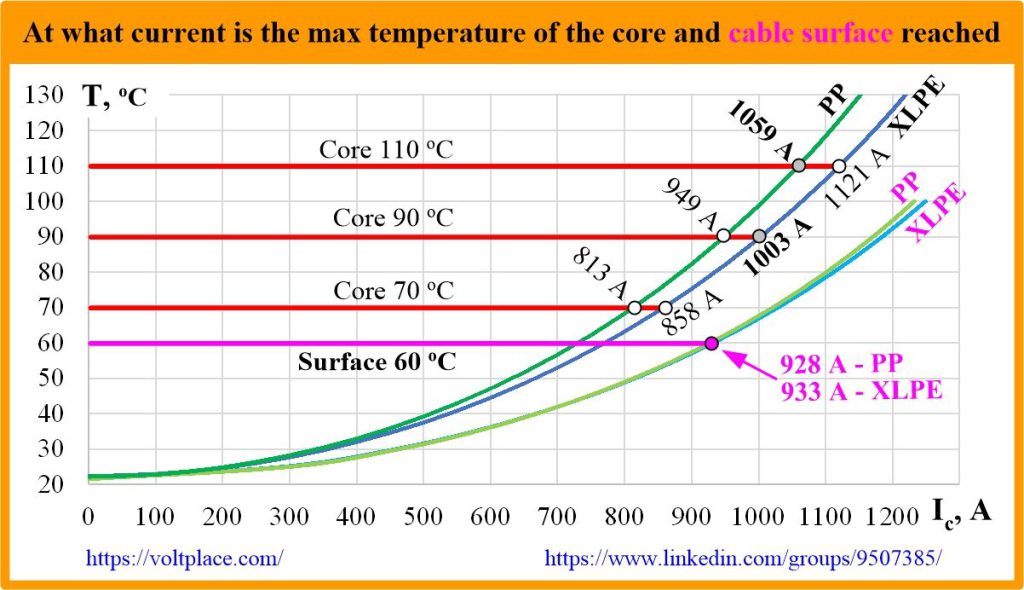
The following updated graph shows:
🔹 cable core temperatures (as it was before).
🔹 cable surface temperatures (a new feature).
If we set the maximum currents corresponding to ampacity (1059 A for PP and 1003 A for XLPE), we will see that the surface temperature will be approximately 75 and 67°C, respectively. That is, PP gives us higher ampacity (+5.6%) but, at the same time, is more dangerous in terms of soil drying and pipe deformation (+8°C).
If we set the surface temperature to 60°C to exclude drying of the soil and deformation of the pipe, we will see that this temperature for PP and XLPE is reached at almost the same current (928 and 933 A, respectively). Thus, PP loses its ampacity advantages over XLPE (if we set the surface temperature at the certain safe level).