
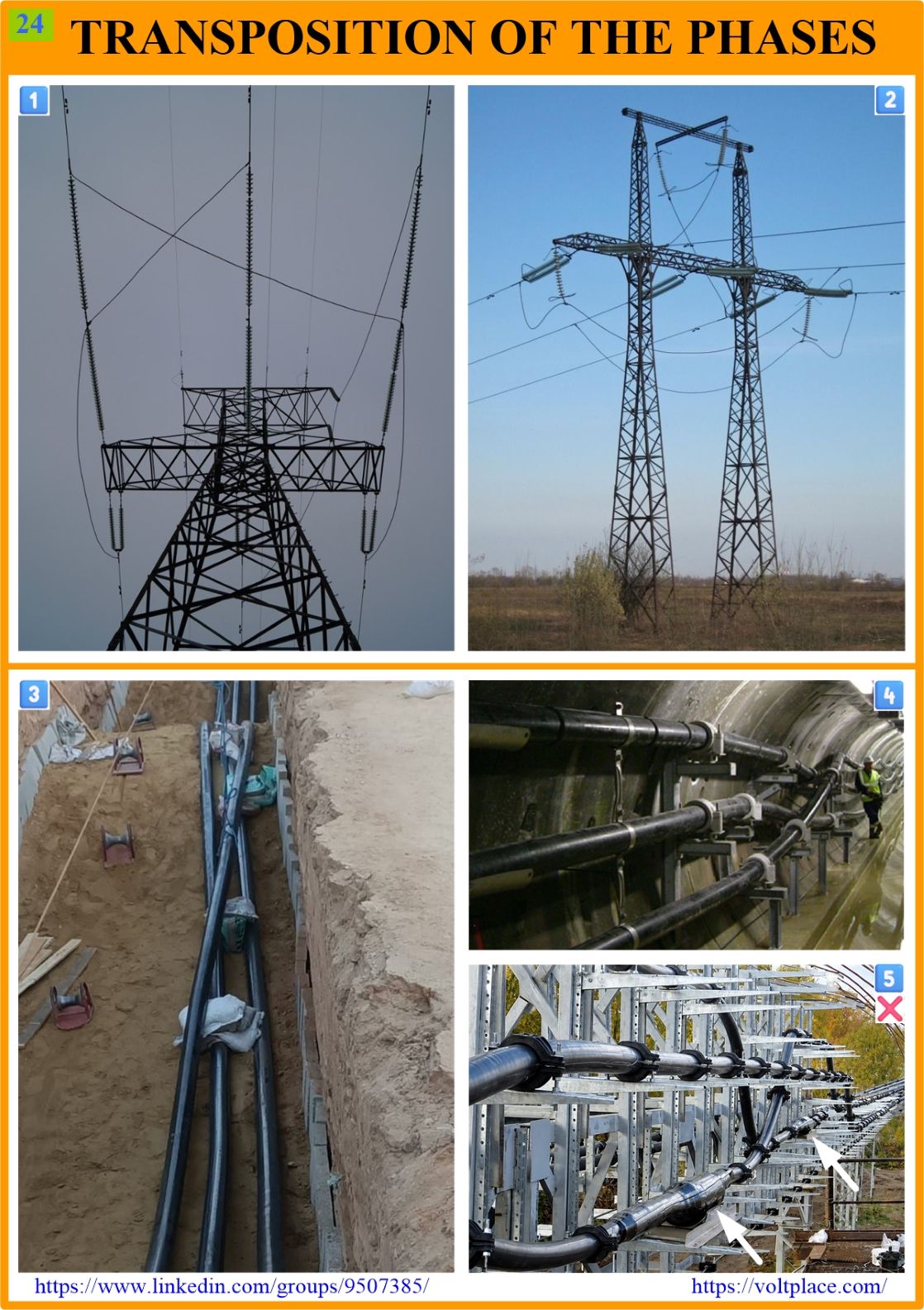
Transposition of the phases
In practice, “transposition of the phases” has to be found for both overhead lines (OHL) and cable lines. Here we note that for cable lines there is also another type of transposition – “transposition of phase screens”, called “screen cross-bonding – it is well-known, and calculation methods have been developed for it, allowing us to understand when cross-bonding is needed and what are economic benefits from its use. However, the same cannot be said about the “transposition of the phases”, the rationale for which is not so well-developed, and sometimes it is difficult to justify the need for such a transposition and the benefits of its use.
So, today we are talking about the phase transposition. Let us explain why it is needed, and what is the difference between its functions for overhead and cable lines.
✅ OVERHEAD LINES. When the phase wires are arranged in a row:
🔹The capacitance of the middle phase is 5-10% higher than that of the two extreme ones. Therefore, the reactive power generated by the middle phase is higher than that of the extreme ones, which is not good.
🔹The inductance of the middle phase is 5-15% lower than that of the two extreme ones. Therefore, with a three-phase short circuit behind the line, the short-circuit current in the middle phase is higher, which is not good.
These issues become especially relevant for long-range high-voltage lines, since they generate significant reactive power. The solution is transposition. Examples are shown in 1️⃣ and 2️⃣, for high-voltage single-circuit lines since it is them where the arrangement of phases in a row is common.
✅ CABLE LINES. They have the following features:
🔹The capacitance of all phases is the same (due to grounded screens);
🔹The inductance differs between phases, but cable lines are usually not so long that their impedance affects the short-circuit currents of the network or the voltage drop in normal operation.
It turns out that for cable lines, unlike overhead ones, transposition of the phases is not necessary. However, it is actually needed. Why?
The transposition of cables (phases) is done to reduce the interference that the magnetic field of a operating circuit makes to a nearby disconnected one. In 3️⃣, the cable line is double-circuit (one circuit has been laid, and the rollers have already been installed for pulling the second one). In 4️⃣, the cable line is also double-circuit (photo just shows the left half of the tunnel).
Note – In 5️⃣, the line is single-circuit, but it seems that a transposition has been made for it. This impression of 5️⃣ is erroneous, and in fact there is no transposition. This arrangement of cables was required to create a platform for mounting the cable joints. But there is no phase transposition for 5️⃣.
So, the phase transposition is needed:
✅ overhead lines: to equalize the phase parameters;
✅ cable lines: to make cables less dangerous for personnel.
You can discuss this post on LinkedIn, in the “High Voltage Cable Lines” group, by following the link to the post.