
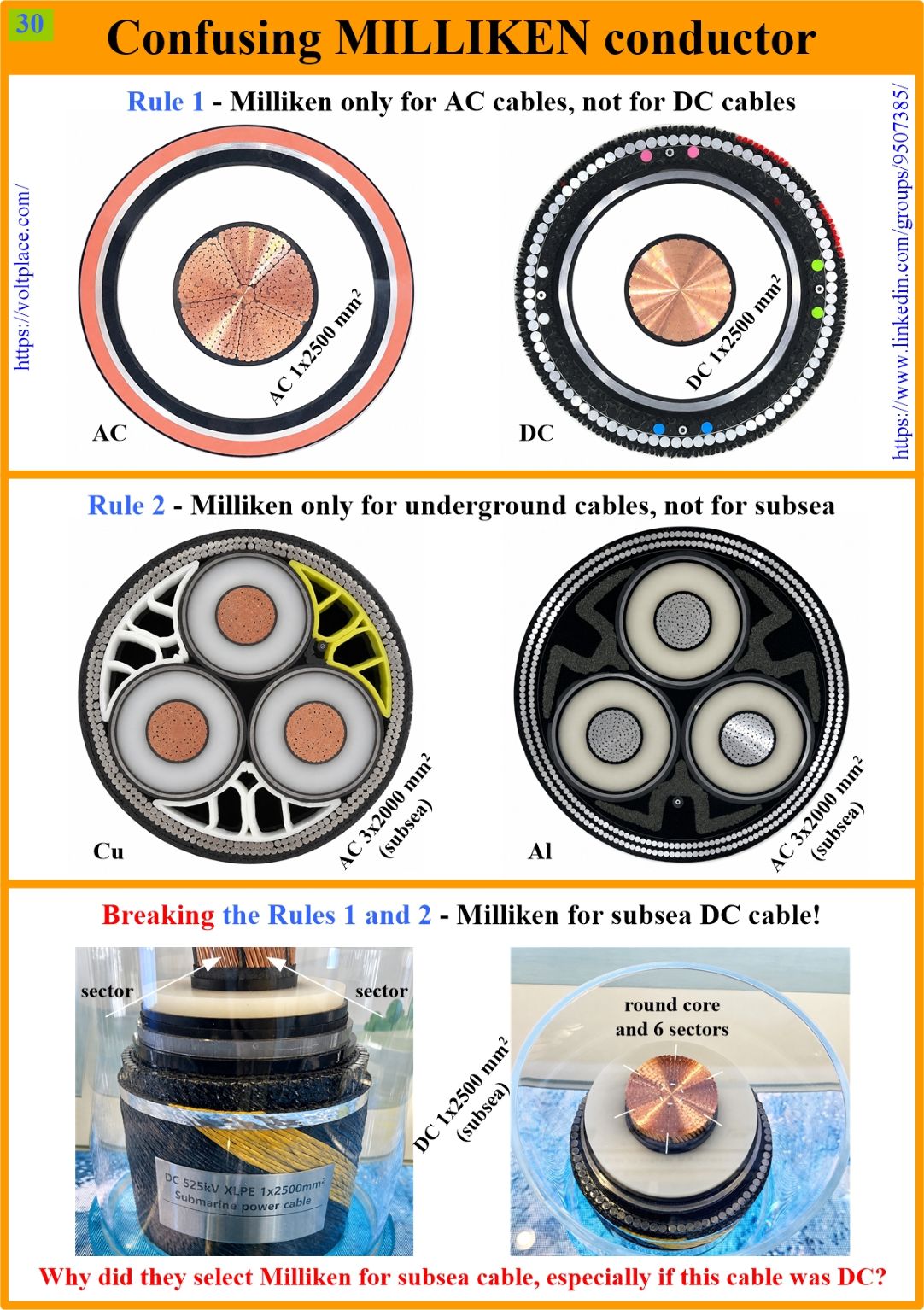
Rules for Milliken conductor
Let us take a quick overview of what I saw during my visit to CIGRE 2026. A lot of cables of the highest quality were presented by various factories. For example, I saw:
➡️ cable of 750 kV voltage class (1.5 times higher than 500 kV);
➡️ cable with copper conductor of 4000 mm2 (four thousand);
➡️ cable with aluminium conductor of 5000 mm2 (five thousand).
I’m not sure I fully understand the purpose of such cables. However, I was sure that I understood when to use Milliken type of conductors and when not. A conductor of Milliken type (with one or another number of sectors, usually 5-6) significantly reduces the skin effect in the conductors, and this solution is recommended:
✅ for copper conductors with a cross-section of 1000 mm2 and above;
✅ for aluminium conductors with a cross-section of 1200 mm2 and above.
In case of DC cables, there is no alternating magnetic field, no current displacement to the outer surface of the conductor, no skin effect, no need to make Milliken for the conductor. So, I was aware of Rule 1 – no need for Milliken in DC cables.
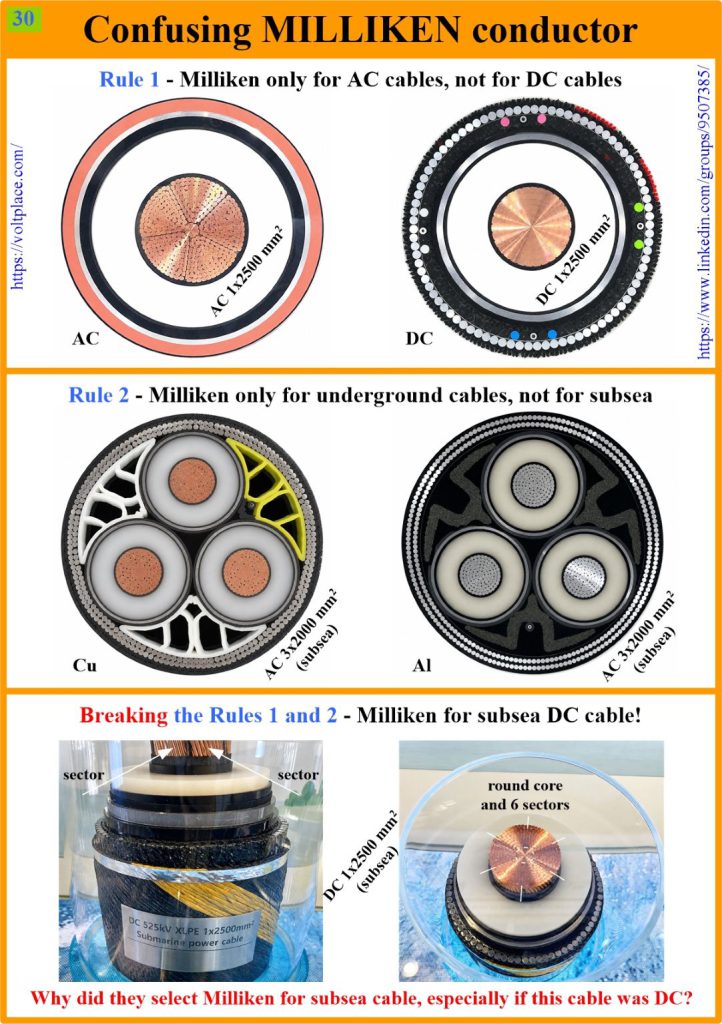
However, I saw it at the exhibition that there were cables with a cross-section up to 5000 mm2, which had no Milliken. After discussion it turned out that besides Rule 1, there is also Rule 2. It lies in the fact that it is difficult for Milliken-type conductors to ensure a high degree of longitudinal sealing of the conductor, and therefore for subsea cables (where protection from the spread of water along the conductor is especially important) it is necessary to abandon Milliken. Thus, we have Rule 2 – for subsea cables, Milliken must be discarded in order to achieve a high degree of longitudinal tightness.
Rules 1 and 2 together can be formulated as follows:
1️⃣ We use Milliken only for AC cables (1000-1200 mm2 and above);
2️⃣ We use Milliken only for underground cables (not for subsea ones).
Imagine my surprise when I discovered one quite unique DC 525 kV subsea cable with a 2500 mm2 copper conductor – it is shown in two photos from below. It can be seen that the conductor consists of 6 sectors around a central round core, that is, it is a typical Milliken. Hence, the questions related to Rules 1 and 2:
❓ What is the purpose of making Milliken if the cable is a DC cable❓
❓ Is it safe enough to make Milliken for subsea cable or not❓
Perhaps I’m just looking at the technological limitations of a particular cable manufacturer, because of which it can only produce 2500 mm2 as Milliken?
You can discuss this post on LinkedIn, in the “High Voltage Cable Lines” group, by following the link to the post.