
The smart LINK BOX
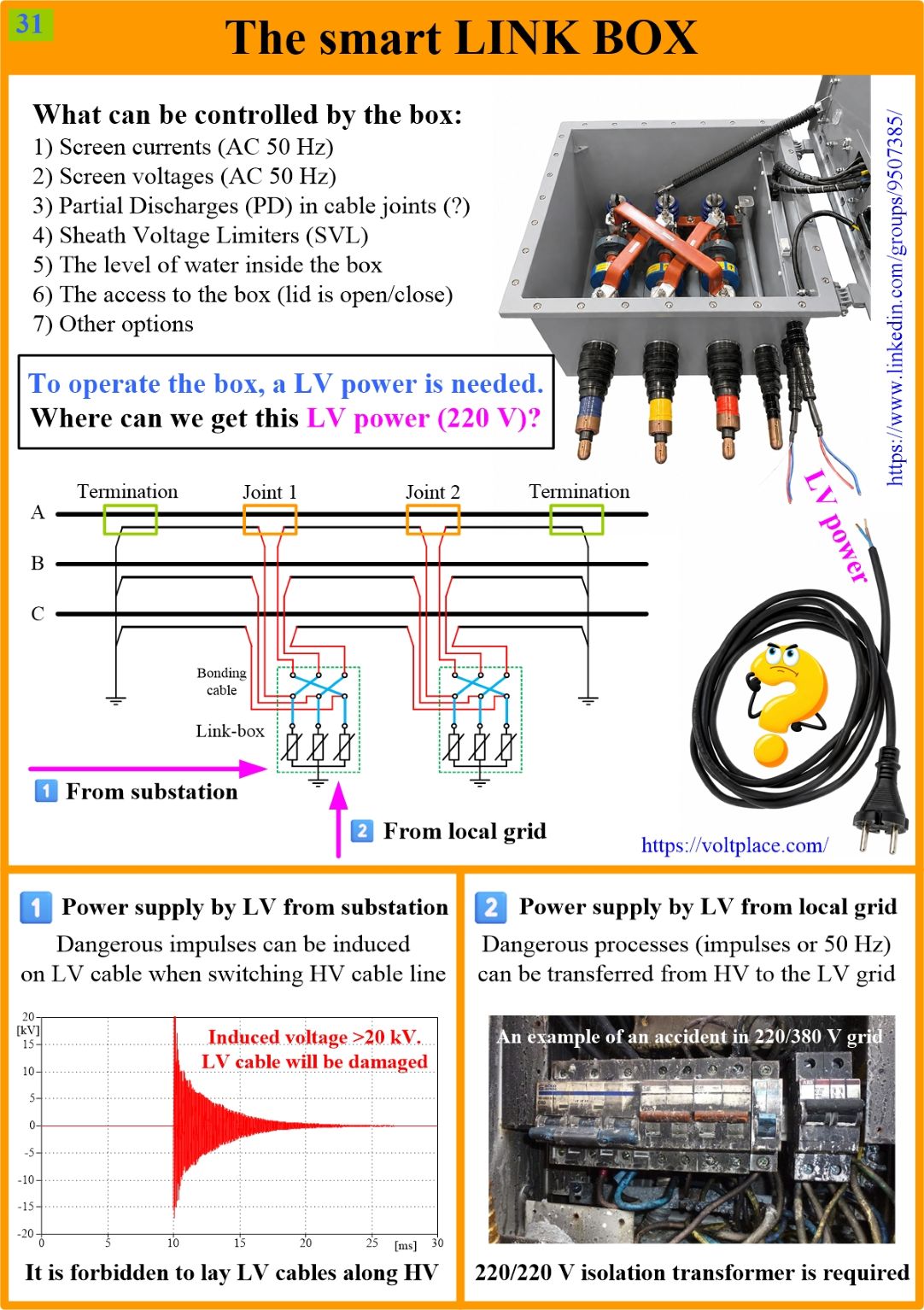
There are so many problems in the nodes of the cross-bonding of screens of single-core 6-500 kV cables. For example, issues of electrical safety of members of the society, issues of water penetration, issues of periodic inspection and testing, etc. Considering all the above, it is only welcome that the factories that produce Link Boxes are trying to equip their products with various measurement and control systems. Such new boxes may be called as “Smart boxes” or “Intelligent boxes”.
Of course, most of these upgraded boxes require power, and the question arises – where to get it from? We are talking about a total power of no more than 100 W (per box) consumed at a Low Voltage (LV), say, of 220 V, that is, we are talking about a current of no more than 0.5 A. Although these are the minimum power and current, the search for a power source should be taken as seriously as possible.
Most often, we can hear two power supply options:
1️⃣ Get power via long LV cable from the switchgear of stations or substations located at the ends of the main High Voltage (HV) cable line (that is, it is necessary to lay the LV cable along the HV cable line).
2️⃣ Get power via short LV cable from the local LV grid.
Both options seem good, but on closer inspection they are not.
Option 1️⃣, frankly speaking, should be prohibited, since it is dangerous to lay LV cables along HV lines. This is related to those leads that may be from the main HV line to LV cable. For example, induced voltages on LV can be:
🔹Of impulse nature, in case of switching of the HV line.
🔹Of 50 Hz, in case of the precense of short circuit currents in the HV line.
Option 2️⃣ is more attractive, but it is still may be dangerous. In case of short circuits on the main HV line, the boxes are usually damaged, which means that a potential of several kV (50 Hz) can be transferred from the HV line to a local LV grid and can lead to damage to LV equipment, fires, and electrical injuries. To avoid such dangerous consequences, it is necessary to separate the LV grid and the box connected to it. To do this, for example, separation transformer (220/220 V) can be provided between the box and the local LV grid. However, there can be no 100% guarantee that it would completely solve the problems.
Since options 1 and 2 seem not safe enough (especially option 1), we can suggest considering other options to establish power supply of the box:
3️⃣ Power from local renewable sources (for example, a pole is placed next to the box on which the solar panel is mounted)
4️⃣ Power from the screens of the main HV line (in normal mode, depending on the load current in the HV cables, the 50 Hz induced voltage on the cable screens ranges from 10-20 to 100-200 V, and this is enough to charge some kind of local battery installed either in the box itself or next to it).
We can say that a “smart box” needs “smart power” ⚡⚡⚡
You can discuss this post on LinkedIn, in the “High Voltage Cable Lines” group, by following the link to the post.