
Cable voltage designations
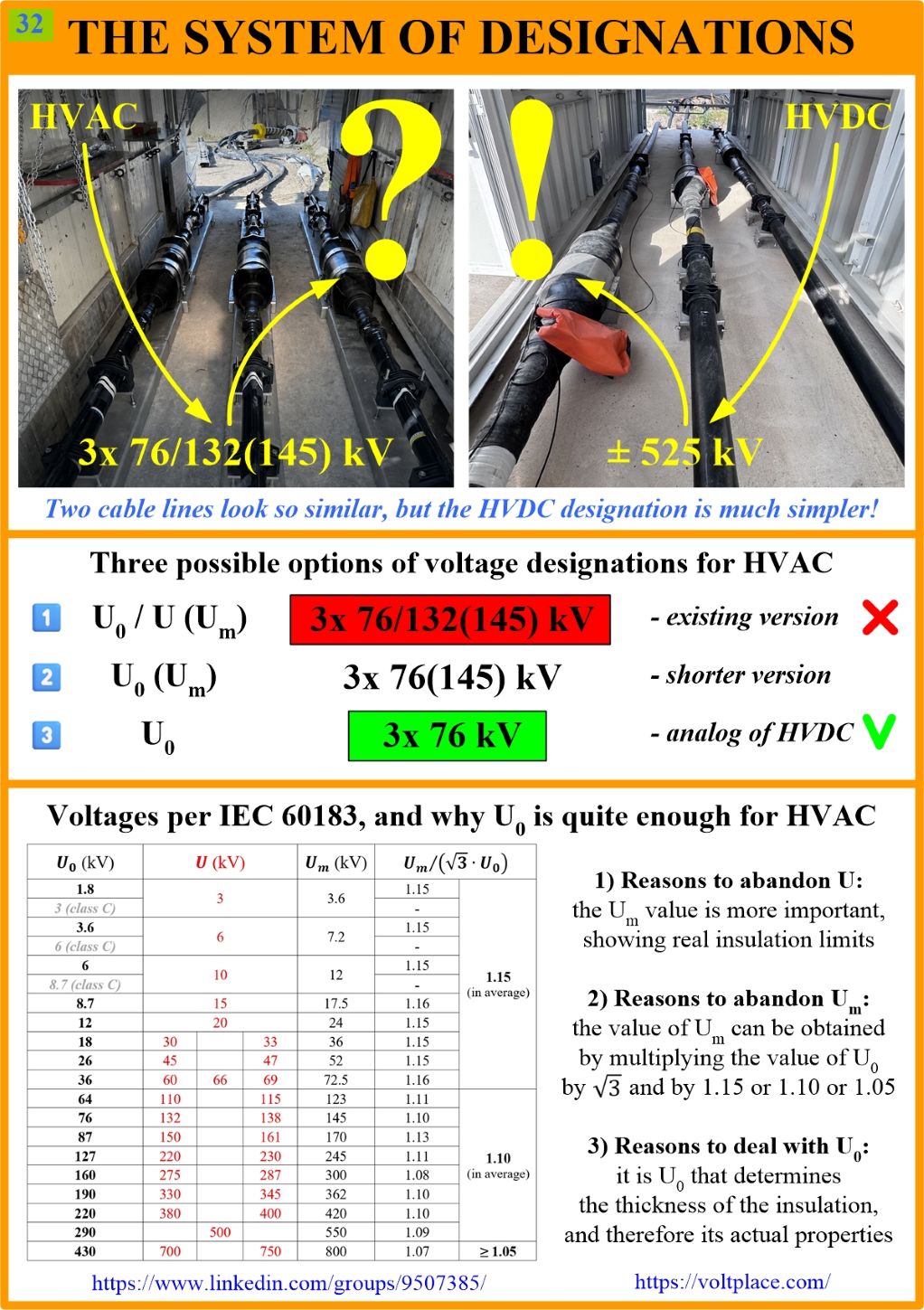
The designation of cables usually includes the voltage classes, the conductor and screen cross-sections, and numerous letters describing various design features. Today, let us discuss only the voltage classes. To understand the problem, please take a look at the two cable lines shown in the photos:
➡️ High-voltage alternating current (HVAC) three-phase line.
➡️ High-voltage direct current (HVDC) bipolar line with ground cable.
Externally, both lines differ little, but the differences in designations are impressive. Why do we need 3 different voltages (U0, U, Um) to mark one HVAC line?
In the past, we were always told that all these voltages allow us to correctly take into account many influencing factors specific to HVAC. For example:
✅ Features of the selection of cables for medium voltage networks (3-35 kV) depending on the method of grounding the neutral of the network (class A,B,C networks per IEC 60502-2).
✅ Various systems of rated voltages of electrical networks available in different regions of the world (say, Europe and the USA).
✅ The need to ensure that voltage classes of the cables correspond to the voltage classes of accessories (joints and terminations).
Nowadays, looking at two almost similar cable lines (HVAC and HVDC) and the catastrophically long designation of HVAC (compared to HVDC), it seems that it’s time to change something.
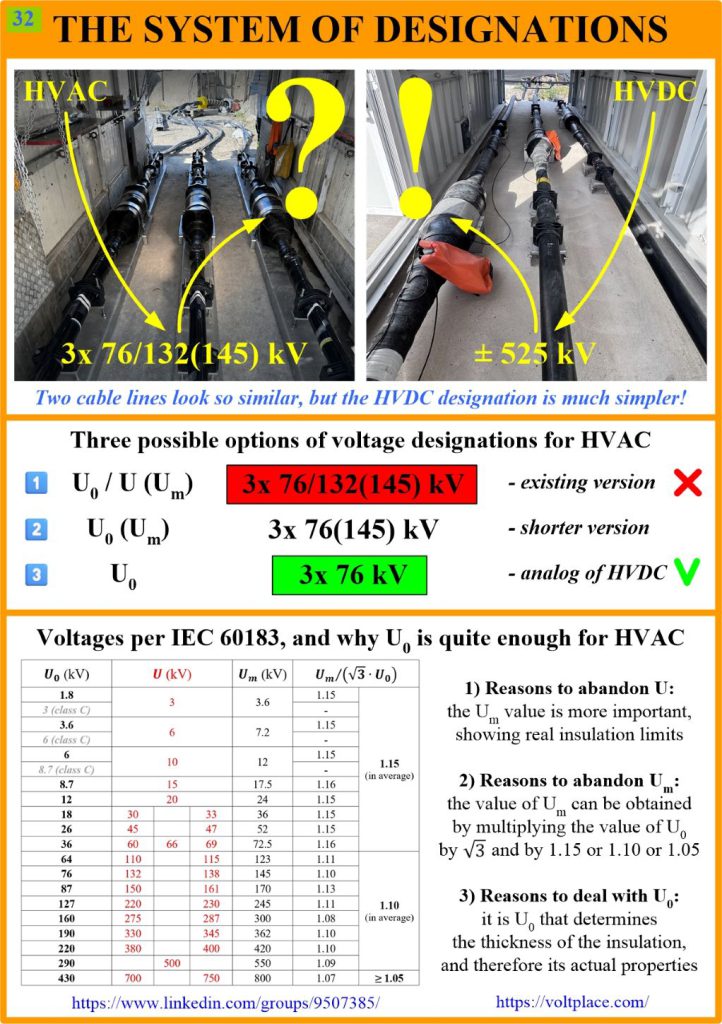
There are three possible options for naming HVAC cables:
1️⃣ U0/U(Um) – the existing option (so strange compared to HVDC).
2️⃣ U0(Um) – a shorter option.
3️⃣ U0 – the shortest option.
Looking at option 1️⃣, it’s not clear why should we be interested in the voltage U. We are interested in the thickness of the cable insulation (hidden in U0) and, just in case, in the highest operating voltage possible for the cable line (hidden in Um). The value of U seems to be excessive.
Looking at option 2️⃣, it’s not clear why do we need to use Um voltage if it is directly connected to U0 through the root of 3, as well as a factor of margin (Class C networks per IEC 60502-2 are not included here):
🔹15% – for 1-70 kV networks (classes A and B per IEC 60502-2).
🔹10% – for 110-500 kV networks.
🔹5(7)% – for 750 kV network, although there are almost no such cables.
Looking at option 3️⃣, it seems it’s quite enough to designate HVAC cables. It means that it’s enough to specify U0 only, which is the cable’s “phase-to-ground” voltage. And this is not a surprise, because all cables for networks from 3 kV and above are equipped with grounded metallic screens and they do not have “phase-to-phase” insulation (they have only “phase-to-ground”).
For HVAC, 1️⃣ should be replaced with 2️⃣ or even with 3️⃣. Don’t you agree?
You can discuss this post on LinkedIn, in the “High Voltage Cable Lines” group, by following the link to the post.