
Many cables in parallel
We understand that laying many cables in parallel creates certain difficulties, but there are cases when it is not possible to avoid such laying. For example, many cables are often typical in the vicinity of a switchgear, where it is necessary to connect lines to many switches. To place cables in such “narrow places”, it is usually necessary to create a duct bank – to lay several rows of ducts in the ground, located on top of each other. For example, for medium voltage, to accommodate 12 cable lines, it would be possible to make:
✅ 2 layers of ducts, of 6 in each layer;
✅ 3 layers of ducts, of 4 in each layer.
However, today let us look at a simpler case – 12 lines are laid in the ground without ducts, at the bottom of the wide trench. This is exactly the case that our colleague Frédéric LESUR wrote about in his post https://lnkd.in/p/etG6GB5E
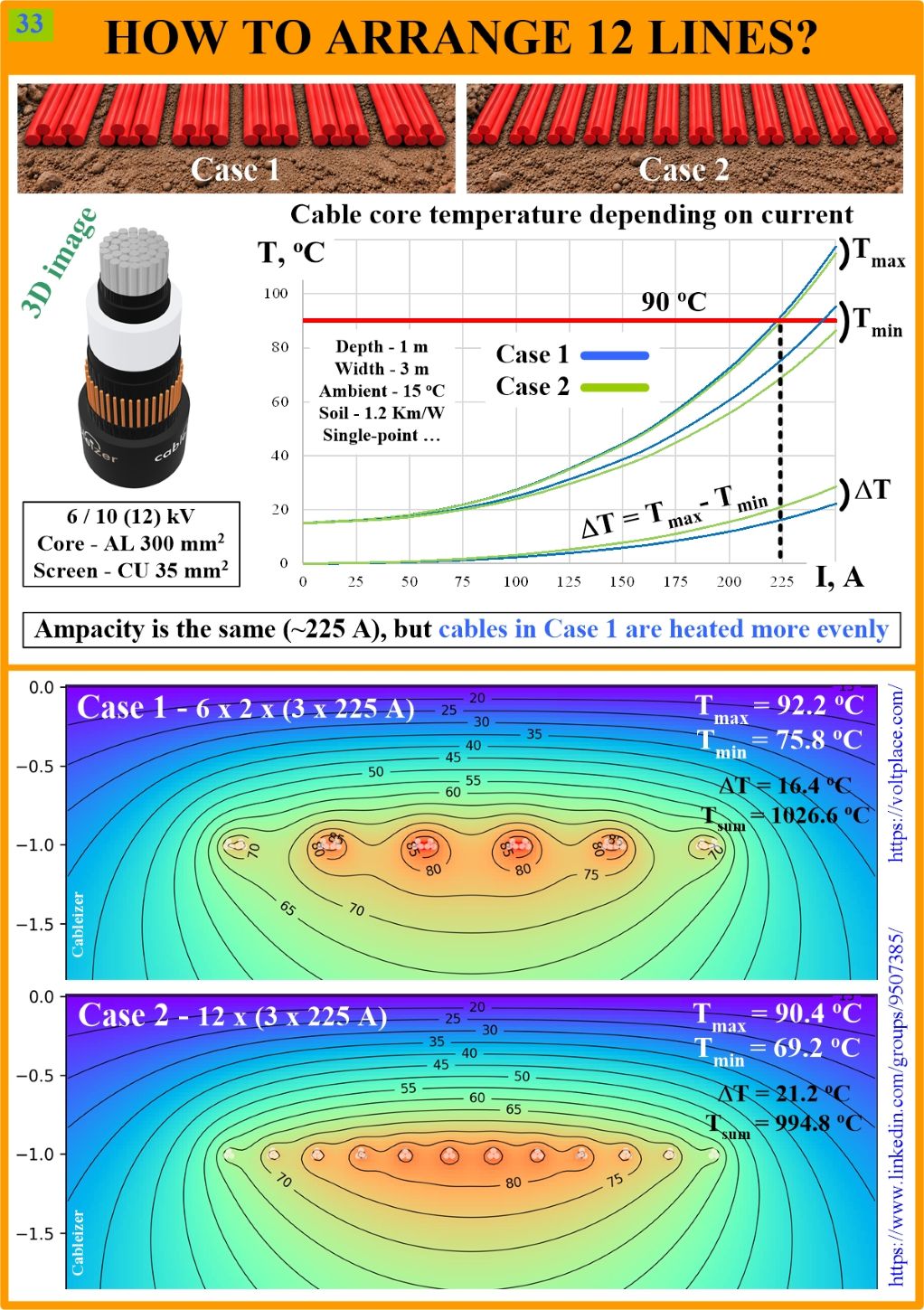
Laying 12 lines in the ground in a plane, without ducts, is more advantageous in terms of cable cooling conditions, but let us look at two cases:
1️⃣ – 12 lines are divided into 6 pairs;
2️⃣ – 12 lines are evenly spaced.
Let us assume that the currents in the cores of all cables are the same (which never happens in practice, since the cables are connected to different consumers). In such conditions, it seemed that 2️⃣ would be better in terms of cable cooling conditions. However, according to thermal calculations, both cases appeared to be almost the equal:
♨️ ampacity is the same (223 and 225 A, respectively);
♨️ the temperature difference between the hottest and coldest cables is less for 1️⃣ (that is, the cables in 1️⃣ are heated more evenly which seems to be an advantage of 1️⃣);
♨️ the sum of temperatures of the cables in a little bit higher for 1️⃣ (which seems to be disadvantage of 1️⃣) – but have you ever heard of such a criterion as “sum of temperatures”?
Clearly, thermal calculations are not enough to choose between 1️⃣ and 2️⃣. Therefore, we must talk about other factors such as magnetic field and consequences of short circuits.
For medium-voltage cable lines, the magnetic field above the ground is generally below accepted values, and the only thing is the magnetic field at the bottom of trench, which is important, for example, for personnel when performing repairs on one of the lines while others are in operation. According to calculations by Cableizer software, the magnetic field among cable groups for 1️⃣ is less than for 2️⃣, which seems to be an advantage of 1️⃣.
So, if, for some reason, we had to choose between 1️⃣ and 2️⃣, then from the point of view of thermal and magnetic field calculations, both options are almost the same, and it even turned out that 1️⃣ is slightly better. The only thing that seems to be clearly wrong with 1️⃣ is the possibility that damage to the insulation of one cable line will affect the adjacent one, since the lines are not separated from each other.
You can discuss this post on LinkedIn, in the “High Voltage Cable Lines” group, by following the link to the post.