
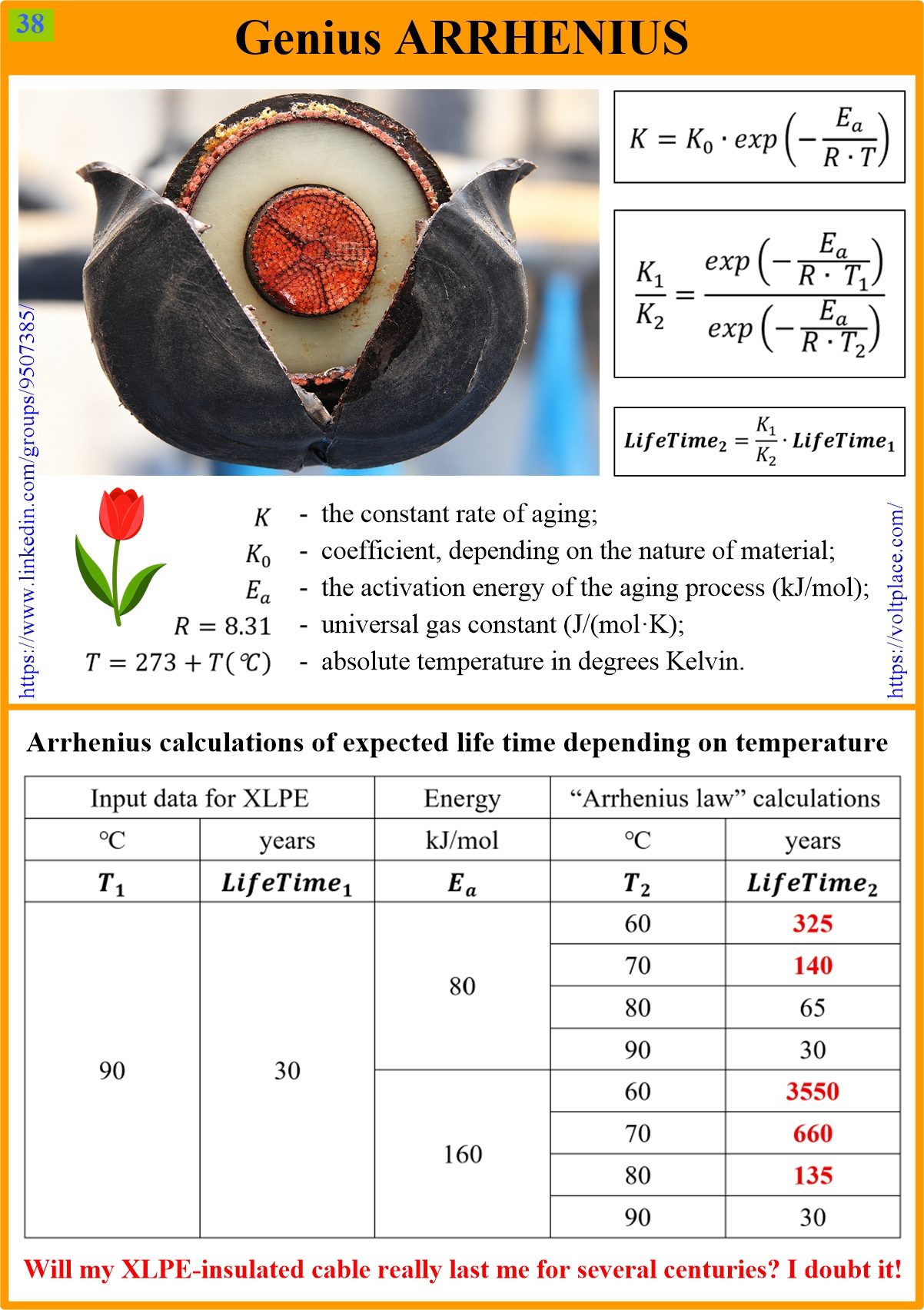
Arrhenius law for cable insulation
Most new cables with a voltage rating above 1 kV use cross-linked polyethylene (XLPE) insulation. It is generally assumed that such insulation will last at least 30 years when subjected to a continuous operating temperature of 90°C. However, usually cable lines operate at temperatures no higher than 60°C for the greater part of their service life. This raises the question: how long would a cable last if it were operated under such “milder” conditions?
To determine the potential service life (and how much it might exceed the 30-year period) one often turns to the Arrhenius equation (it provides the rate of aging as a function of temperature, that is K=f(T)). The principle is that when the temperature drops, the chemical reaction slows down, and in the context of cable insulation, this means that the destruction process should also slow down.
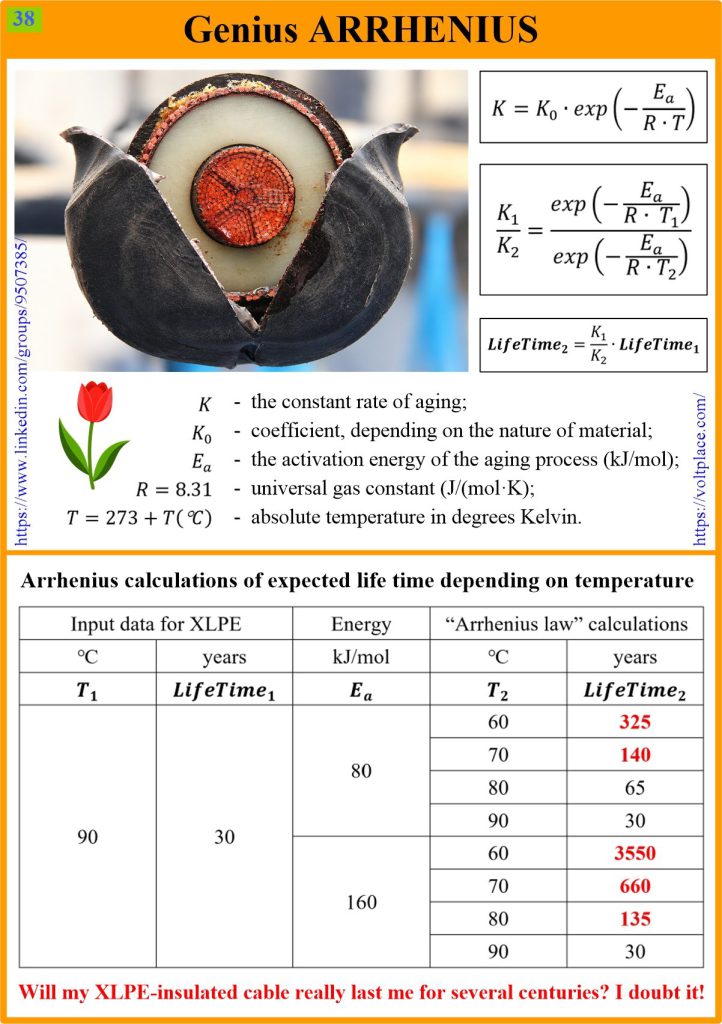
While the Arrhenius equation is frequently cited, calculation results are rarely presented. Let us attempt such a calculation. If a reaction proceeds at a rate K1 at temperature T1, then at a lower temperature (T2 < T1), the reaction rate will also be lower (K2 < K1), and the service life will increase proportionally (LifeTime2 > LifeTime1). The relevant formulas are provided on the slide.
To perform these calculations, one must know the constant Ea (activation energy). This value depends on both the material and the temperature, and publications typically cites values Ea ranging from 80 to 160 for polymer insulation. The table shows the estimated service life (LifeTime) based on both values (80 and 160).
It can be seen, as the Arrhenius equation suggests, if insulation can last 30 years at 90°C, it would theoretically remain functional for several centuries at 60°C. This is very difficult to believe.
It is possible that the Arrhenius equation is not applicable to polymer insulation. It is also possible that the service life of insulation is determined not only by temperature but also by the following factors, which are not accounted for by the Arrhenius law:
➡️ electric field stress;
➡️ the quality of cross-linking and degassing;
➡️ the condition of the semiconducting screens;
➡️ moisture and water treeing;
➡️ overvoltages and partial discharges.
In any case, we get the impression that the Arrhenius equation, in its conventional form, is not particularly well-suited for polymer insulation. It would be interesting to know your opinion. You can share it on LinkedIn, in the “High Voltage Cable Lines” group, by following the link to the post.