
Laying cables over bridges
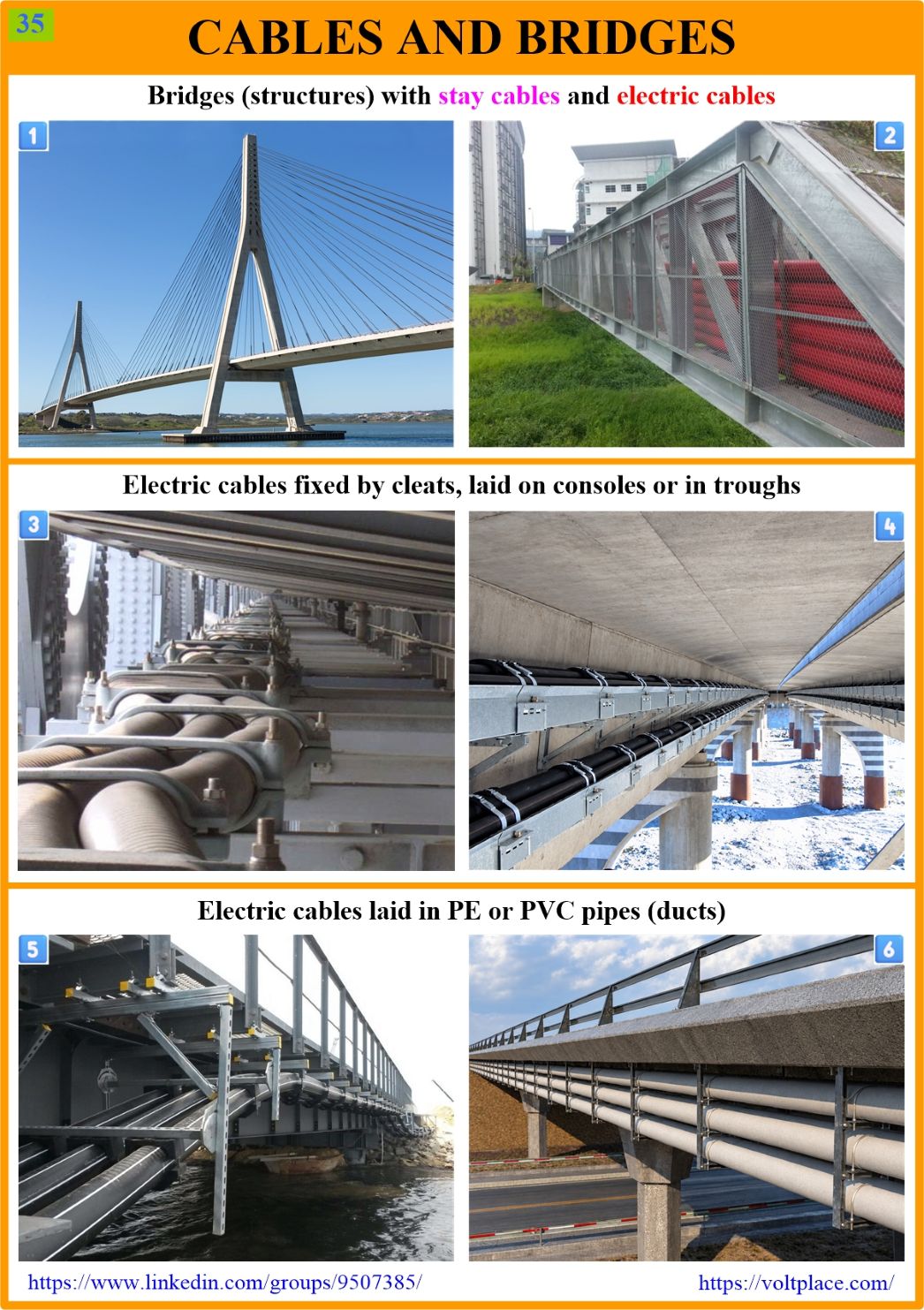
Before this conversation, let us agree that when talking about bridges, by the word “cable” we will mean exactly “electric cables”, and not at all “stay cables”, which are necessary to hold bridge structures in their position (they are shown in 1️⃣). So, today let us discuss “electric cables” only.
Laying electric cables and cable lines above the ground, over bridges 1️⃣ and various structures 2️⃣, is not the easiest way, as many tasks must be solved many of which simply do not exist when laid in the ground.
For example we need to provide the protection of cables from:
✅ solar radiation (to avoid damage to the cable sheath, as well as to avoid excessive heating by direct sunlight).
✅ flame and fire.
✅ vibration (due to wind or transport).
✅ temperature fluctuations in the length of bridge structures.
✅ traction currents (if any).
✅ vandals and theft.
It is also required to think about following issues:
✅ compensation of temperature fluctuations in the length of the cables themselves.
✅ compensation of temperature fluctuations of pipes (ducts) in which cables are laid (if any).
✅ providing the possibility of repairing or re-laying cables.
✅ magnetic field (because the cables may be located close to members of the public).
✅ proper grounding.
To solve all these problems, we should carefully approach the search for the optimal location for cables on bridges 1️⃣ and structures 2️⃣, as well as choose the most appropriate methods of laying and fastening. Possible options are listed below.
3️⃣ – Lay the cables along the metal consoles and fix them with cleats. At the same time, it is necessary to arrange cables snaking to compensate for temperature fluctuations in the length of cables and bridge structures.
4️⃣ – Lay the cables in metal (or other) troughs. The cables still need to be fixed to avoid their movements in case of short circuits. However, the troughs probably make it possible to reduce the number of bridge’s consoles required for cable laying.
5️⃣ – Lay in PE-based pipes, which are fixed to the structures by plastic cleats (5) or metal arcs (6). It should be borne in mind that the coefficient of thermal expansion of PE is about 0.00018, then heating a pipe with a length of 100 m from 20 to 85℃ will increase the length of the pipe by 0.00018*100*(85-20) =1.17 m, and this must be compensated somehow. For example, by leaving a gap between pipes, covered with a larger diameter pipe. It is also important to note that pipes should not be made of HDPE, but of less combustible grades and compositions.
6️⃣ – Lay in PVC pipes. One of advantages of PVC is in their coefficient of thermal expansion which is about 2.5 times less than that of PE. Therefore, the lengthening of the pipes will be less and will be less than 0.5 m for a 100 m long section, which is easier to compensate for.
Which option of laying 3️⃣-4️⃣-5️⃣-6️⃣ is the best will depend on many factors. However, option 5️⃣ (PE pipes) seems to be the worst. Don’t you agree?
Or, for example, vibration – is it worth being afraid of?
You can discuss this post on LinkedIn, in the “High Voltage Cable Lines” group, by following the link to the post.