
Rated voltage of the bonding cable
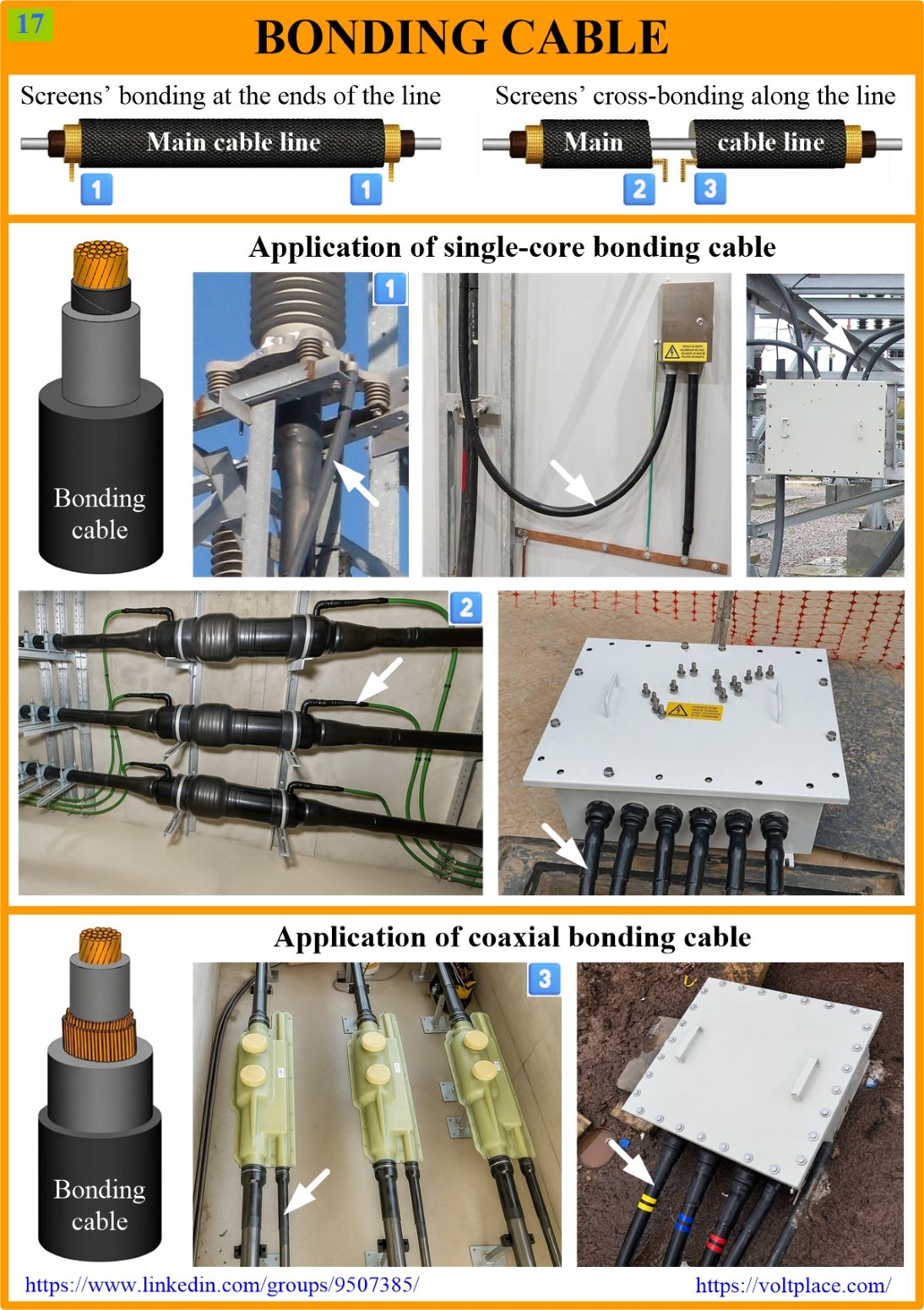
What is the rated voltage of the bonding cable? Let us talk about this. Recall that bonding cable is usually necessary to connect the screens of the HVAC line built with single-core cables. There are 3 most known cases:
1️⃣ Terminations. The connection of each termination to the box is made by a single-core bonding cable. Each termination may have its own box, or there may be one common box for three terminations (for three phases).
2️⃣ Joints. The connection of 3 joints to common box is made by 6 single-core bonding cables.
3️⃣ Joints. The connection of 3 joints to common box is made by 3 coaxial bonding cables (with 2 conductors of equal cross-section).
The boxes may have inside the jumpers for grounding the screens or for connecting the screens with each other. The boxes may be equipped with surge arresters (sheath voltage limiters, SVL). There are many manufacturers of boxes and terminations/joints whose products differ significantly. But today, let us focus only on bonding cable. As we can see, bonding cable comes in two basic designs:
✅ single-core (cases 1️⃣ and 2️⃣).
✅ coaxial (case 3️⃣).
The cross-section of the conductors of the bonding cable is usually assumed to be equal to the cross-section of the screen of the main line. The bonding cable inside can have water-blocking tapes, and its sheath can be single-layer (insulation and sheath functions are combined together) or double-layer (separation of functions: one is responsible for insulation, the second has the properties of a sheath). The sheath can be UV-resistant, low-smoking, halogen-free, with a semi-conductive coating. However, what should be the rated voltage of the bonding cable?
Obviously, the bonding cable used to connect the screens of the main line must have insulating properties no worse than the outer sheath of the main line. However, there is a concept of rated voltage of the main insulation for the main line, but there is no such concept for the sheath, and all that we know is the sheath thickness. Therefore, we must follow the same rule for bonding cable – we must set its insulation/sheath thickness (usually it is at least 3 mm for the outer layer and about 5 mm for the inner of coaxial), but we cannot specify any rated voltage (Ur) there.
Here’s what we know:
➡️ In terms of 3-5 mm insulation, bonding cable is about Ur=6-10 kV.
➡️ During transients, the screen voltage can be up to 50-100 kV, and it is acceptable for Ur=6-10 kV.
➡️ In case of a short circuit, the screen voltage can be up to 5-10 kV or more for a short time, and it is acceptable for Ur=3 kV.
➡️ In normal mode, the screen voltage is less than 100-200 V, and it means low voltage Ur<1 kV.
We can see, that there are arguments for the rated voltage to be from 1 kV to 6-10 kV, without a definite answer. Therefore, we should not ask the question “what is the rated voltage of the bonding cable?” It is important to focus on the thickness of the layers and not on the rated voltage.
You can discuss this post on LinkedIn, in the “High Voltage Cable Lines” group, by following the link to the post.
AFTERWORD
The requirements for bonding cable can be found at least in the following documents: IEEE 575; British Standard C55; CIGRE TB 797 (Appendix C). In the documents, we can find the thickness of the bonding cable layers, but nowhere “the rated voltage of the bonding cable” is indicated. And the same situation with “the rated voltage of the sheath of the main line”. Therefore, let us stop asking each other about “the rated voltage of the bonding cable”.