
Aluminium tape over the cable screen
The design of high voltage cables is quite elegant, and therefore it seems simple. In fact, the apparent simplicity hides hundreds of big and small problems, as well as years of research by a large number of specialists, hundreds of kilometers of bad-quality cable thrown in the trash, and significant economic losses for all market participants. Today let us talk about “AL tape” (aluminuim tape or alumopolymer tape).
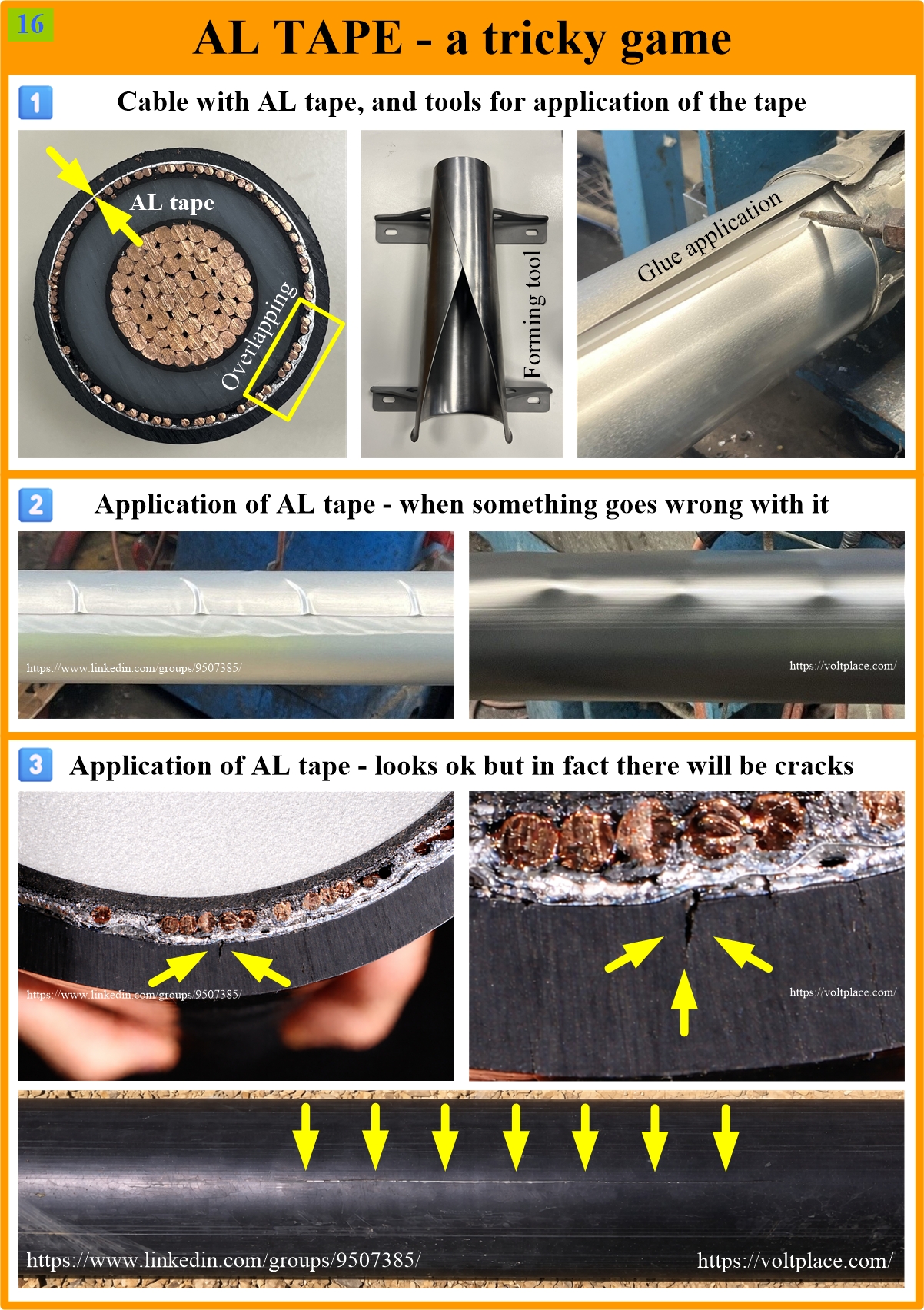
1️⃣ AL tape is used when cables are subject to increased requirements for protection against water penetration, which is important, first of all, when laying cables in the ground. AL tape can be found not only on most 110-500 kV cables, but also on many 6-35 kV cables.
AL tape is applied simultaneously with the extrusion of the cable outer sheath (jacket). The questions that have to be answered are at least these:
🔹 Is it better to glue the edges of AL tape or weld them?
🔹 How can the tape be safely transformed from a flat state (the tape is supplied in coils) to a round state (when it covers the cable) without deforming edges of the AL tape?
🔹 Which overlap of the AL tape layers is sufficient?
🔹 Which glue should be used and what temperature characteristics should it have? (if the glue melts at low temperature, then it can’t keep tape closed during cable sheath extrusion and during cable operation).
🔹 What should be the glue consumption? (a lot of glue helps to keep AL tape better, but will create a protrusion at the point where the tape layers overlap).
🔹 How to ensure the adhesion between the AL tape and the outer sheath?
2️⃣ If the transformation of AL tape from a flat state to a round one occurs too quickly, over a short distance – this leads to the edges of the tape going a longer way than the middle part of the tape, and thus the edges of the tape are stretched. As a result, when closing the tape, the stretched edges have nowhere to go, and they form the protrusions shown in the photo. In such places, the sheath may crack, for example, when pulling a cable or during its operation. Therefore, the choice of the forming tool is important.
3️⃣ Even if the forming tool and the glue parameters are selected correctly, and the cable looks good, the tape can still give unpleasant surprises. The fact is that the overlap of the tape layers creates additional mechanical stresses in the outer sheath. As a result, during the operation of the cable, due to repeated heating/cooling cycles, microcracks can develop in the cable sheath, which may cause the sheath to break, as shown in the photo.
It turns out that the AL tape, designed to protect the cable, in fact led to a violation of the protection. A crack in the sheath of a laid cable is a significant loss for all industry participants.
Most cable manufacturers face AL tape problems in one form or another. This is the case when a more complex cable design does not always turn out to be more reliable and profitable.
You can discuss this post on LinkedIn, in the “High Voltage Cable Lines” group, by following the link to the post.