
Foundation for cable termination
Cable terminations are an essential element of every cable line. As the voltage class increases, the size of terminations and their cost increase significantly. Today let us discuss the supporting structures on which cable terminations are placed. Usually, such structures are the responsibility of the designer (or builders), and they need to be informed on what’s good for a termination and what’s bad for it. Let us give 5 examples, starting with the worst option and ending with one of the best.
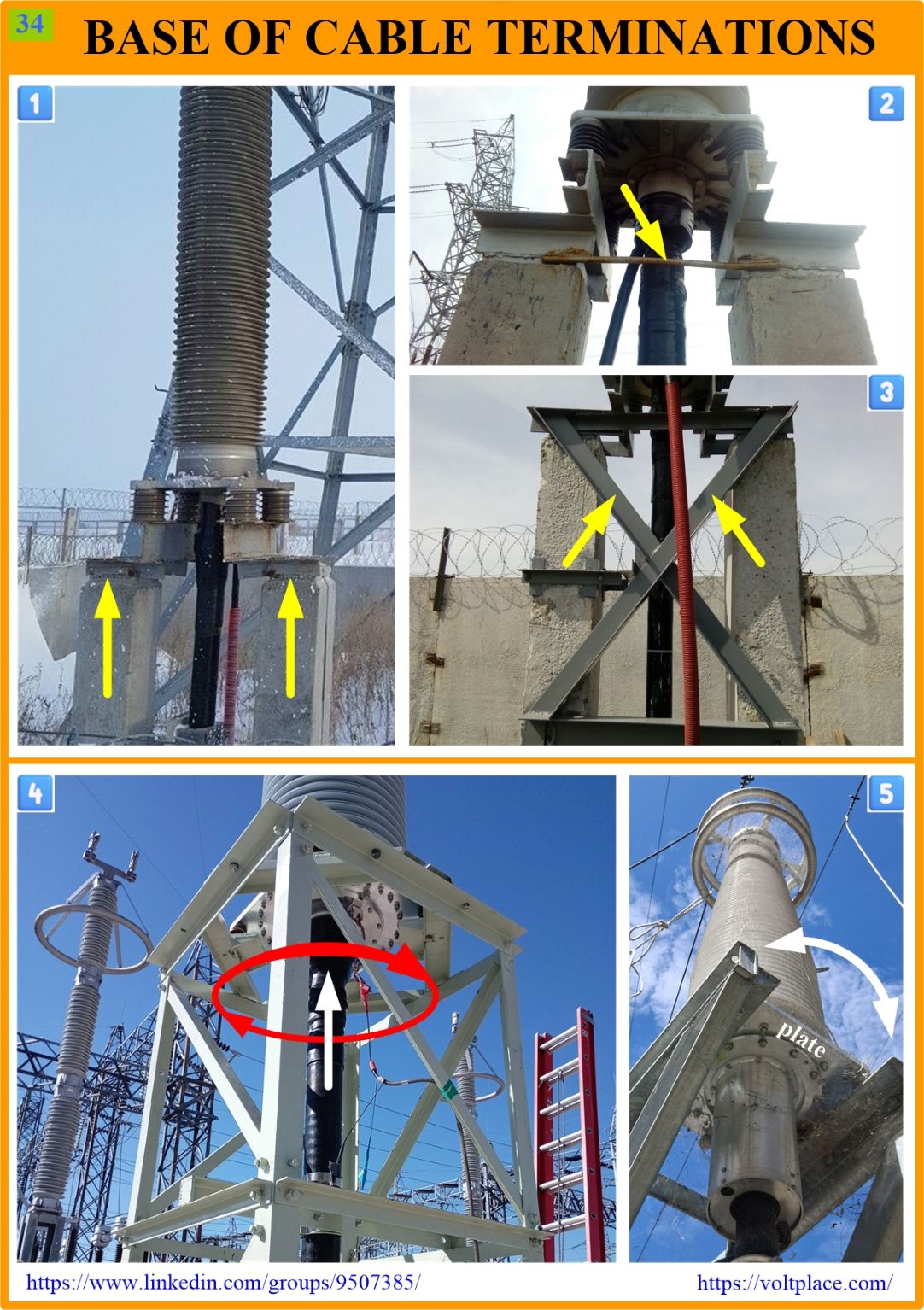
1️⃣ A termination mounted on two vertical concrete poles. The design is quite simple and inexpensive, but it can cause serious problems for the termination, oil leakage and subsequent short circuits. These problems may arise because each of the two poles may independenly shift vertically during their operation, which is associated, for example, with freezing of the soil in winter or excessive watering of the soil during the rainy season. As a result, the termination can tilt, thereby creating excessive mechanical stress inside its body (in particular, at the point where the cable enters the termination). There may be an oil leak in this place, and if it is not noticed in time, a short circuit is guaranteed.
2️⃣ A termination, where, based on operational experience, it was decided to link two poles together to minimize their movement relative to each other. Obviously, a single rod is not enough to solve the problem.
3️⃣ A termination where two poles are already securely tied together with the help of structural steel angles, and then we should not expect any mechanical stresses in the termination associated with the possible movement of the poles. However, this solution seems “homemade”.
4️⃣ A termination that stands on a rigid structure assembled from structural steel angles. The solution looks light, easy to assemble manually, without the use of a crane (which is needed for installation of concrete poles). However, another problem is possible here – in normal operation, an AC 50/60 Hz current (shown by vertical arrow) passes through the cable, which creates a magnetic field that “rotates around the cable.” Such a field closes in the metal elements and causes them to heat up. Therefore, if the shown solution has no problems in terms of mechanics, then it may be undesirable in terms of heating.
5️⃣ A termination that stands on a single rigid structure, and there is no closed loop around the termination and the cable connected to it, which eliminates any heating. The only thing that can be heated due to magnetic field of the cable is the horizontal plate. To avoid this heating, there are several possible options for this plate:
🔹to make it from non-magnetic metal (for example, stainless steel – this is usually an expensive solution).
🔹to make it from magnetic metal but provide an insert in it made of non-magnetic metal.
🔹to make it from magnetic metal but provide an air gap in it (then the base plate will resemble a horseshoe).
You can discuss this post on LinkedIn, in the “High Voltage Cable Lines” group, by following the link to the post.