
Ampacity of the cable line
Have you ever seen that the thermal calculation of a cable line (according to IEC 60287 or in software) takes into account the length of the line? I guess you haven’t. Let’s talk about it today. Usually, to check the temperature of a cable, we know the current in its core (Ic). We could get such a current, for example, from specialists who calculated the normal mode of the network, and such a current (Ic) already includes the following components:
➡️ active-inductive current required by consumers;
➡️ capacitive current (Ic.cap) generated by the line.
At the same time, 6-500 kV cables have metallic screens, and screen current (Is) has the following components:
➡️ circulating current (Is.ind) induced by the core current;
➡️ capacitive current (Is.cap) generated by the line.
For single-core cables, the induced current (Is.ind) depends on the screen bonding type. However, whether there is an induced current or not, a capacitive current (Is.cap) will flow through the screen anyway. So, with any screen bonding type and proportional to the length of the line, we always have the following capacitive components:
✅ in the core (Ic.cap);
✅ in the screen (Is.cap).
We are not very interested in the presence of a capacitive component in the core current, because it has already been taken into account in the core current (Ic) that was given to us as the result of calculations of the normal mode of the network. So let’s focus on the screen.
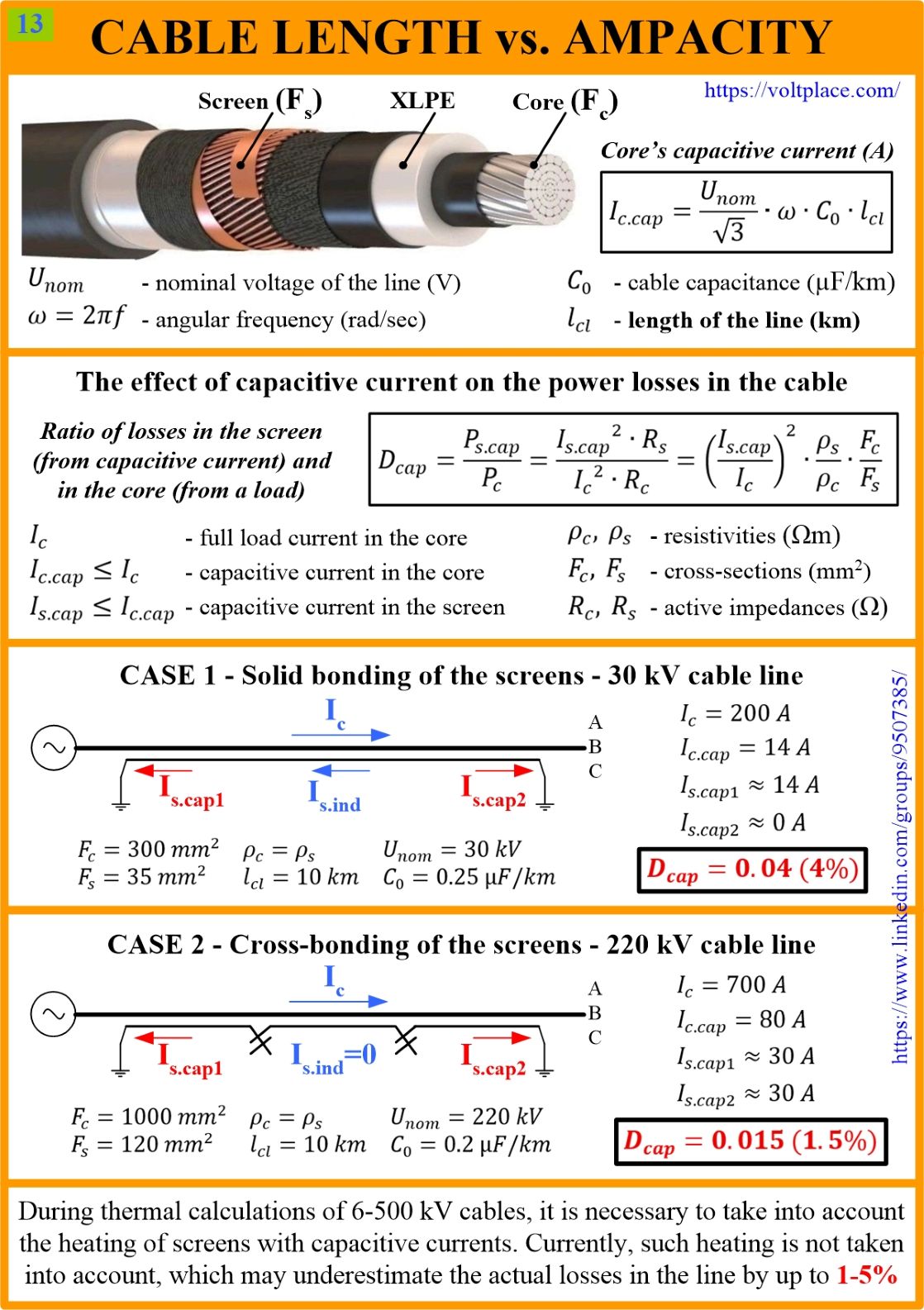
The longer the line, the greater the capacitive current in the screen (Is.cap) and the associated power losses (Ps.cap). Let’s estimate how much losses in screens from capacitive current can be noticeable against the background of losses in the core from the total current (Ic). There are two examples.
1️⃣ 30 kV line. The capacitive current that flows from the core through the insulation into the screen then flows from the screen to the ground. However, according to EMTP, almost all the capacitive current goes towards the supply network (Is.cap1). This current creates losses in the screen (in the beginning of the line), which amount to 4% of the losses in the core.
2️⃣ 220 kV line. According to EMTP, the capacitive currents in the screens at the beginning of the line (Is.cap1) and at the end of the line (Is.cap2) are equal, and as a result of compensation (by cross-bonding), they are less than the total capacitive current of the line. This current creates losses in the screen (at any of both ends of the line), which amount to 1.5% of the losses in the core.
The longer the line, the greater its capacitive currents. And the more these currents heat up the cable screens (and insulation). However, IEC 60287 does not take into account the length of the line and its screen capacitive current, which leads to errors in the calculation of heat dissipation in the cable.
The longer the cable line – the greater the error in ampacity calculations. The error could be up to 1-5% and even more.