
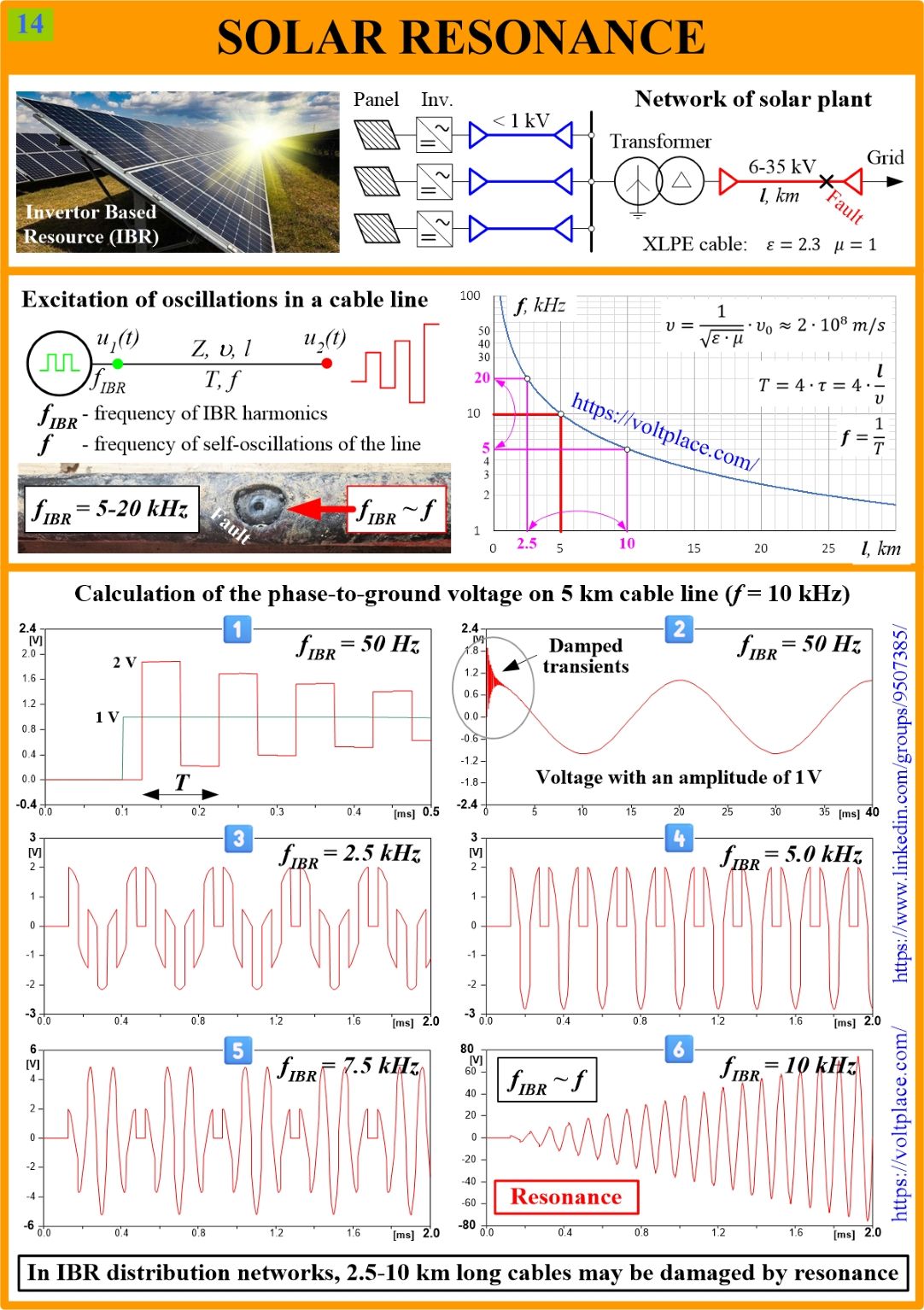
Cable damage due to inverter harmonics
The number of renewable sources is increasing. If we talk about solar parks, some of them have already reached a capacity of hundreds MW and export power at a voltage of up to 400 kV. However, the basis of solar parks, consists of low-voltage DC cables and medium-voltage AC cables.
What problems are known for solar parks (apart from the insufficient quality of design documentation, materials used and installation work):
❌ Solar parks, unlike traditional power stations with rotating machines, do not have sufficient inertia, which leads to a decrease in the stability of the system (such problems were in 2025 in Spain-Portugal).
❌ A significant number of low (and medium) voltage cables laid in the same trench requires complex thermal calculations; the problem of ensuring uniform current distribution between cables is also known.
❌ Harmonics generated by inverters lead to overheating and fires of power transformers, and to other consequences.
Let’s talk about another possible manifestation of harmonics. As we know, inverters are equipped with filters, but they are not always efficient enough, and therefore voltage harmonics in frequencies from 5 to 20 kHz enter the network (this is essentially the frequency with which the inverter valves are controlled). Let’s see if such a frequency can be dangerous for cables.
For XLPE-insulated cables, the wave velocity (V) is 1.5 times less than for overhead lines (Vo). Knowing the speed and the length of the line, we can find the period of natural oscillations (T) of the line and the corresponding frequency of natural oscillations (F). If this frequency is close to that generated by inverters (Fibr), then resonance may occur on the line and insulation breakdown.
Estimates show that the natural oscillation frequency F = 5-20 kHz is typical for cable lines 2.5-10 km long. For such lines, the presence of harmonics of a frequency of 5-20 kHz in the network can provoke resonance. We will show this by connecting a cable line to an AC voltage with an amplitude of 1 V, and we will vary the frequency of this voltage (Fibr).
1️⃣ 50 Hz. A damping oscillatory process occurs on the line.
2️⃣ 50 Hz. Repeats 1️⃣, but for a different timespan. It can be seen that the transient process is attenuated, and the voltage on the cable is a pure AC 50 Hz sine wave with an amplitude of 1 V.
3️⃣ 2.5 kHz.
4️⃣ 5 kHz.
5️⃣ 7.5 kHz.
6️⃣ 10 kHz. The voltage reaches 80 V, that is, 80 times more than that of the source.
The calculations (with a number of serious assumptions) were performed to show a simple fact – a cable line can significantly amplify harmonics created by inverters. Therefore, the resulting voltage on the cable line (the sum of 50 Hz and harmonics) may be higher than acceptable.
It should be expected that there is a certain range of cable lengths (several km) when poorly filtered inverter frequencies can even create resonance. This dangerous range of lengths in solar parks is typical for medium-voltage cables, not low-voltage ones. Unfortunately, some cases of damage to 6-35 kV cables are already known. Interestingly, some of them occurred 5-10 minutes before sunrise – probably, this is the time when the inverters “wake up” and change their operating mode in some way that turns out to be fatal for the cable. This led to the idea of the possibility of resonance described in this post.
You can discuss this post on LinkedIn, here is the link.